Trucking business licensing is the process of securing all required federal and state permits, driver qualifications, and vehicle registrations that legally authorize a trucking operation to transport goods. Getting this right from day one separates operators who hit the road in weeks from those stuck in compliance delays for months. The full picture includes a USDOT number, Motor Carrier (MC) operating authority, Commercial Driver’s Licenses (CDLs) for drivers, International Registration Plan (IRP) plates, IFTA fuel tax credentials, and proof of insurance. This guide breaks down every step, the real costs, and the 2026 compliance nuances you need to know before you spend a dollar on a truck.
Trucking business licensing explained simply: you need both federal authority and state-level registrations before you can legally haul freight. The MC application process typically spans 4 to 8 weeks from initial business formation to fully active authority. Plan for that window from day one.
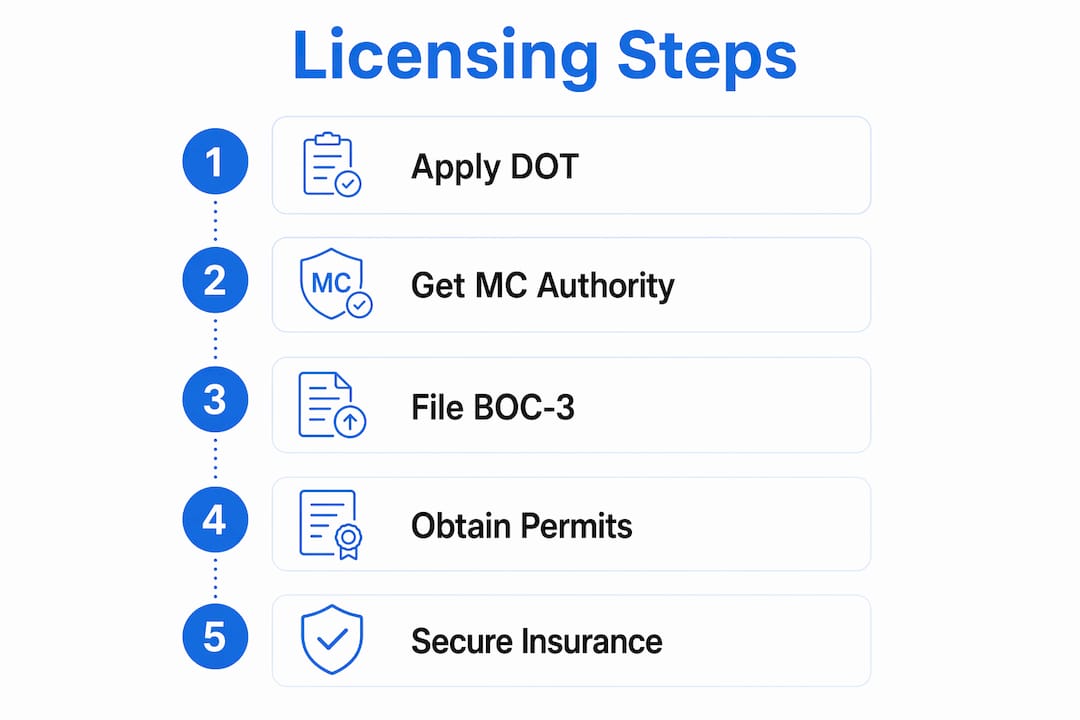
The required steps follow a specific order:
Pro Tip: File your BOC-3 and insurance certificates the same week you submit your MC application. Both must be on file before FMCSA flips your authority to active, and delays here are the most common reason new carriers miss their target launch date.
The total startup cost for federal licensing alone runs roughly $330 to $400 when you include the MC fee and BOC-3 filing. State fees, insurance, and vehicle registration add significantly more.

A Class A CDL is required to operate commercial combination vehicles, including tractor-trailers. Business owners do not need to personally hold a CDL unless they drive trucks themselves. Every driver you hire, however, must hold a current Class A CDL with the appropriate endorsements.
The CDL acquisition process follows three stages:
The full CDL process takes 4 to 12 weeks. State DMV fees run $200 to $500. Professional CDL training programs cost $3,000 to $8,000 depending on the school and program length.
Common endorsements your drivers may need include the Hazardous Materials (H) endorsement, Tanker (N) endorsement, and Double/Triple Trailer (T) endorsement. Each requires an additional written test, and the H endorsement requires a TSA background check.
Pro Tip: Factor CDL training costs into your startup budget before you hire. If you plan to drive yourself, start your CLP application the same week you file for your USDOT number. The 14-day CLP hold period and the FMCSA protest period overlap, saving you time.
Licensing does not end at startup. Running a legal trucking operation requires annual renewals and quarterly filings that carry real penalties if missed. Carriers must maintain IRP apportioned plates, UCR registration, IFTA fuel tax credentials, and HVUT for heavy trucks.
| Requirement | Cost | Frequency |
|---|---|---|
| IRP apportioned plates | $1,500 to $3,000 per truck | Annual renewal |
| Unified Carrier Registration (UCR) | Starting at $46 for small fleets | Annual |
| IFTA fuel tax credentials | Minimal state fee | Annual credential; quarterly filing |
| Heavy Vehicle Use Tax (HVUT) | Based on vehicle weight | Annual (IRS Form 2290) |
| State mileage-based taxes | Varies by state | Quarterly or annual |
HVUT applies to trucks over 55,000 lbs. You file IRS Form 2290 annually, typically by august 31 for the tax period beginning july 1.
States like New York, New Mexico, Kentucky, and Oregon impose mileage-based taxes separate from IFTA. These are not optional. Failure to register or file triggers delays and penalties. Kentucky, for example, requires zero-mileage tax filings even if no travel occurred in the state. Missing that filing can trigger penalties up to $500 and potential permit revocations.
For a deeper look at how these requirements interact with your DOT compliance obligations, small fleet owners should review state-specific rules before crossing new state lines.
Insurance is not optional and not cheap. New trucking companies pay $8,000 to $15,000 annually for minimum liability coverage. Premiums are heavily influenced by driver safety records and Motor Vehicle Records (MVRs). A clean MVR can reduce premiums significantly for startup carriers.
FMCSA sets the minimum liability insurance at $750,000 for general freight carriers. Carriers hauling hazardous materials face higher minimums. Beyond liability, you should carry:
The ELD mandate requires electronic logging devices on trucks over 10,001 lbs. Hardware costs $300 to $700 one-time, plus a monthly subscription fee. ELDs replace paper logs and automatically record hours of service (HOS) data. Non-compliance triggers roadside violations and out-of-service orders.
One costly misconception: the BMC-84 surety bond is only required for brokers and freight forwarders, not motor carriers. Motor carriers who skip this bond correctly save $750 to $9,000 annually. Do not let a filing service upsell you on a bond you do not legally need.
Pro Tip: Shop insurance before you finalize your driver roster. Insurers price policies based on each driver’s MVR. One driver with a poor record can raise your entire fleet’s premium. Pull MVRs during the hiring process, not after you’ve already committed.
For a full breakdown of your liability insurance options, Goeldhub’s 2026 guide covers current premium ranges and coverage structures for new carriers.
The 21-day FMCSA protest period is the largest unavoidable delay in the startup process. Most new carriers treat it as dead time. Effective operators treat it as a preparation window.
Here is how to use that time:
“The 21-day protest period is not a waiting room. It is your last chance to build the compliance infrastructure that keeps your authority active once you have it.”
Plan your cash flow before you apply. Insurance premiums, IRP plates, and ELD hardware can total $12,000 to $20,000 before you collect your first freight check. Factoring services convert your receivables into working capital quickly, which helps close that cash-flow gap in the first 60 to 90 days of operation.
Trucking business licensing requires federal authority, state registrations, driver CDLs, and ongoing tax filings. Missing any single element can suspend your operating authority or trigger costly penalties.
| Point | Details |
|---|---|
| Federal authority comes first | Apply for USDOT number and MC authority before any other step; budget $300 for the MC fee. |
| CDL is for drivers, not owners | Business owners only need a CDL if they personally operate a commercial vehicle. |
| The protest period is productive time | Use the 21-day FMCSA window to install ELDs, file IRP and IFTA, and build driver qualification files. |
| Ongoing filings carry real penalties | States like Kentucky require zero-mileage tax filings; missing them triggers fines up to $500. |
| Insurance shapes your cash flow | Startup liability premiums run $8,000 to $15,000 annually; clean driver MVRs cut that cost. |
The biggest mistake I see new trucking entrepreneurs make is treating licensing as a checklist they complete once and forget. Trucking compliance is a continuous process. IFTA filings come due every quarter. UCR renewals hit every year. State mileage taxes in Kentucky require filings even when you drove zero miles there. The paperwork does not stop when your authority activates.
The second mistake is the CDL confusion. Entrepreneurs assume they must personally hold a Class A CDL to own a trucking company. They do not. That misunderstanding delays business formation by weeks while owners enroll in CDL school unnecessarily. If you are not driving the truck, focus your energy on the business side.
The third mistake is the surety bond upsell. Filing services sometimes bundle a BMC-84 bond into startup packages. Motor carriers do not need that bond. Brokers do. Paying for it is a direct loss of $750 to $9,000 per year with zero regulatory benefit.
My practical advice: build your compliance calendar before you file your first application. Map every quarterly and annual deadline for IFTA, UCR, IRP, HVUT, and any state-specific taxes on your lanes. Set calendar reminders 30 days out. The carriers who stay out of trouble are not smarter. They are more organized.
— Managment
Getting your authority is step one. Keeping it active is the real job.
Goeldhub is built for small and mid-sized trucking companies that need to manage ELD compliance, driver logs, insurance, and cash flow without a back-office team. For $15 per driver per month, you get FMCSA-compliant ELD compliance tools, driver log management, fuel card discounts, and low-fee factoring to close the cash-flow gap in your first months of operation. The platform supports PT-30 and IOSix hardware, so you do not need to replace equipment you already own. Goeldhub also offers CDL driver recruiting support and a 14-day free trial with no obligation. Start your trial and turn your new authority into a running operation.
Business owners do not need a CDL unless they personally drive a commercial vehicle. Every driver operating a truck must hold a current Class A CDL with the required endorsements.
The MC authority process typically takes 4 to 8 weeks from business formation to active authority. The 21-day FMCSA protest period is the largest single delay in that timeline.
FMCSA requires a minimum of $750,000 in liability insurance for general freight carriers. Startup premiums typically run $8,000 to $15,000 annually depending on driver safety records.
IFTA stands for International Fuel Tax Agreement. Any carrier operating in two or more member jurisdictions must register for IFTA credentials and file quarterly fuel tax reports.
Motor carriers do not need a BMC-84 surety bond. That bond is required only for freight brokers and freight forwarders. Purchasing it as a motor carrier is an unnecessary expense of $750 to $9,000 per year.


.svg)