A freight broker is a federally licensed intermediary who connects shippers with carriers to move freight, without ever owning the trucks or touching the cargo. The broker arranges the transportation deal, manages the paperwork, and earns a margin on each load. For small trucking businesses and owner operators, understanding what a freight broker does is the first step to working with them effectively or even becoming one.
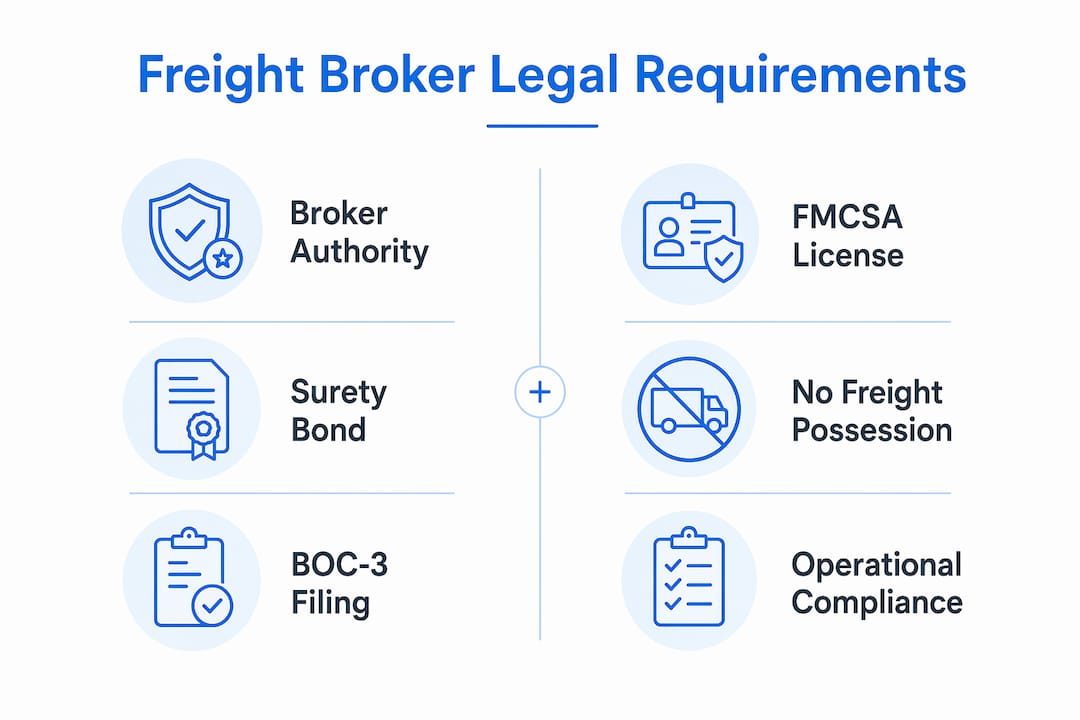
Freight brokers operate under the Federal Motor Carrier Safety Administration (FMCSA) and must meet specific legal requirements before arranging a single load. They hold broker authority, maintain a $75,000 surety bond, and file BOC-3 process agent forms. These requirements exist to protect both shippers and carriers from unqualified middlemen. The freight brokerage industry sits at the center of American supply chain logistics, and knowing how it works gives your trucking business a real advantage.
A freight broker earns income from the spread between two rates: the sell rate charged to the shipper and the buy rate paid to the carrier. That margin is the broker’s revenue on every load. Brokers do not own trucks or cargo, which means their entire business model depends on negotiation skill and relationship management.
Here is how the daily operation works:
The broker’s profit is the difference between those two numbers. A broker moving 20 loads per week at a $200 spread per load generates $4,000 in gross revenue weekly before expenses. That math scales quickly, but so do the costs.
Pro Tip: Track your buy rate and sell rate on every load from day one. Brokers who lose track of their spread often discover they are working for less than minimum wage once overhead is factored in.
Relationship building and market knowledge are the real assets in brokerage. Technology platforms help connect supply and demand, but a broker who knows which carriers run a specific lane reliably will always outperform one who relies on posting boards alone.

Freight brokerage is a federally regulated activity. You cannot legally arrange transportation for compensation without meeting FMCSA requirements. The table below summarizes the core requirements:
| Requirement | Details |
|---|---|
| Broker authority (MC number) | Issued by FMCSA; required before arranging any load for compensation |
| Surety bond or trust fund | $75,000 BMC-84 or BMC-85 required under 49 U.S.C. § 13102 |
| BOC-3 filing | Process agent must be designated in every state where the broker operates |
| Operating agreement | Written contracts with carriers are standard practice and legally advisable |
| Unified Carrier Registration (UCR) | Annual registration required for interstate commerce |
The $75,000 bond is not a fee you pay upfront. You pay a premium to a surety company, which backs the full bond amount. The bond protects shippers and carriers if the broker fails to pay or commits fraud. Missing this requirement means operating illegally, which exposes you to fines and loss of authority.
Brokers who take physical possession of freight or issue a Bill of Lading as the carrier cross into freight forwarder territory. That distinction carries different legal responsibilities and greater liability exposure. Stay clearly on the broker side of that line.
Pro Tip: File your BOC-3 through a registered process agent service before applying for broker authority. FMCSA will not grant authority without it, and delays here slow your entire launch timeline.
The biggest daily challenge in freight brokerage is not rate negotiation. It is managing the volume of communication that comes with every load. A single load at a busy brokerage can generate between 20 and 50 inbound carrier emails as carriers compete for the lane. That volume is a real operational bottleneck that new brokers consistently underestimate.
Each carrier inquiry requires a response, a rate check, and a safety verification. Vetting a carrier means confirming active authority, checking safety ratings, verifying insurance, and reviewing past performance. Doing that 30 times per load, across multiple loads per day, is where brokers burn out or make costly mistakes.
Cash flow is the second major pressure point. Shippers often pay on 30 to 60-day cycles, while carriers expect payment within 2 to 3 days. That gap can cripple a new brokerage fast. A broker moving $100,000 in freight per month may be waiting on $80,000 in receivables while still needing to pay carriers this week.
Practical ways brokers manage these challenges include:
Working capital is not optional for new brokers. It is the difference between staying open and closing after your first slow payment cycle. Plan for at least 60 days of operating expenses in reserve before you book your first load.
Businesses regularly confuse freight brokers and freight forwarders. That confusion leads to mismatched expectations and real operational risk. The core difference comes down to possession and liability.
| Factor | Freight broker | Freight forwarder |
|---|---|---|
| Physical possession of freight | Never takes possession | Takes possession and assumes custody |
| Bill of Lading | Does not issue as carrier | Issues as carrier or principal |
| Liability for cargo loss | Liable only for negligent carrier selection | Liable as carrier for cargo loss or damage |
| Asset ownership | No trucks or warehouses | May own or lease transportation assets |
| Regulatory framework | FMCSA broker authority | FMCSA and often customs/trade regulations |
A freight broker arranges the deal and steps back. A freight forwarder takes responsibility for the shipment from origin to destination, often consolidating cargo and issuing its own documentation. The liability exposure is fundamentally different.
For carriers, this distinction matters when deciding who to work with. A broker who suddenly wants to take possession of freight or issue documents as a carrier has stepped outside their legal role. That is a red flag worth noting before you sign a rate confirmation.
Freight brokers handle compliance management across state and federal regulations, which reduces the administrative burden on both shippers and carriers. That is a genuine value-add, but it does not extend to assuming cargo liability. Know where the broker’s responsibility ends and yours begins.
For small carriers and owner operators, working with freight brokers solves a specific problem: finding consistent freight without spending all day on the phone. Brokers give you access to loads you would never find on your own, especially in lanes where you have no direct shipper relationships.
Key benefits for small trucking businesses include:
The tradeoff is margin. Brokers earn their spread on every load, which means you are not getting the full shipper rate. For many small carriers, that tradeoff is worth it. The time saved on finding freight and managing paperwork often exceeds the cost of the broker’s cut.
Pro Tip: Build relationships with two or three brokers who specialize in your lanes. Consistent volume with a broker you trust beats chasing spot rates across a dozen load boards every week.
Freight brokers are federally licensed intermediaries who earn income from the spread between shipper and carrier rates, without owning trucks or taking possession of freight.
| Point | Details |
|---|---|
| Freight broker definition | A licensed intermediary who arranges transportation between shippers and carriers for compensation. |
| Legal requirements | FMCSA broker authority, $75,000 surety bond, and BOC-3 filing are all mandatory before operating. |
| Income model | Brokers earn the spread between the sell rate to shippers and the buy rate paid to carriers. |
| Biggest operational challenge | Managing 20–50 carrier communications per load while maintaining cash flow across 30–60 day payment cycles. |
| Broker vs. forwarder | Brokers never take possession of freight; forwarders assume custody and carry greater cargo liability. |
After years of working alongside trucking businesses navigating the brokerage world, one thing stands out clearly: the brokers who last are not the ones with the best software. They are the ones carriers and shippers actually want to call back.
Technology has made it easier to post loads, vet carriers, and track shipments. But it has not replaced the value of a broker who knows your lanes, pays on time, and picks up the phone when something goes wrong. That is still the core product in freight brokerage, and no platform replaces it.
Cash flow management is where I see new brokers fail most often. The math looks good on paper until the shipper pays on day 45 and the carrier needed payment on day 3. Building a cash reserve or using factoring before you need it is not cautious. It is the only way to stay in business long enough to build the relationships that make brokerage profitable.
The regulatory side is non-negotiable. Brokers who cut corners on bonding, BOC-3 filings, or carrier vetting do not just risk fines. They risk destroying the trust that took years to build. Compliance is not overhead. It is the foundation your reputation sits on.
The future of freight brokerage belongs to operators who combine solid relationships with smart processes. The brokers who understand both sides of the transaction, shipper needs and carrier realities, will continue to find their place in the supply chain regardless of how the technology changes.
— Managment
Running a trucking business means staying on top of compliance, driver management, and operational costs all at once. Goeldhub is built for exactly that.
Goeldhub provides FMCSA-compliant ELD compliance solutions for small and mid-sized fleets, along with driver log management, fuel card programs, and low-fee factoring to help you close the cash flow gap that brokers and carriers both face. For fleets looking to grow, Goeldhub’s CDL driver support helps you recruit and manage qualified drivers without the usual headaches. All of this starts at $15 per driver per month, with a 14-day free trial and no obligation.
A freight broker is a person or company that arranges transportation of freight for compensation without assuming custody of the goods, as defined under 49 U.S.C. § 13102. FMCSA broker authority is required to operate legally.
Freight brokers earn the spread between the rate charged to the shipper and the rate paid to the carrier. Revenue is generated load by load, with no ownership of trucks or cargo involved.
Freight brokers must maintain a $75,000 surety bond (BMC-84) or trust fund (BMC-85) under federal law. This bond protects shippers and carriers if the broker fails to pay or commits fraud.
A freight broker arranges transportation without taking possession of the freight, while a freight forwarder assumes custody of goods and issues a Bill of Lading as a carrier. Forwarders carry greater liability for cargo loss or damage.
Yes. Freight brokers give small carriers access to freight they would not find through direct shipper relationships, and they handle compliance and administrative tasks that would otherwise consume driving time.


.svg)