A trucking safety program is a structured system of policies, workflows, and training designed to prevent accidents, maintain FMCSA compliance, and protect your drivers and equipment. The industry term is a “fleet safety management program,” though “trucking safety program” is the phrase most small operators use day to day. A well-built program does more than check regulatory boxes. Fleets with formal safety programs experience 40–60% fewer accidents and 15–30% lower insurance premiums. That combination of risk reduction and cost savings is why every small trucking company needs one, not just the large carriers.
A trucking safety program is a documented, actively managed system that covers every aspect of how your fleet operates safely. The FMCSA defines the six core components every compliant program must include: a written safety policy, driver qualification files, Hours-of-Service management, vehicle maintenance, drug and alcohol testing, and an incident investigation workflow.
Each component carries real weight. Your written safety policy sets the rules every driver follows. Driver qualification files, governed by 49 CFR Part 391, document that each driver meets federal standards before they ever turn a key. HOS compliance keeps fatigued drivers off the road. Vehicle maintenance records under 49 CFR Part 396 prove your trucks are roadworthy. Drug and alcohol testing protects everyone on the highway. Incident investigation turns every accident into a lesson that prevents the next one.

A complete program also integrates technology. Telematics, dash cams, and electronic logging devices give you real data on driver behavior. That data is what separates a program that works from one that just sits in a binder.
Here is what a complete program covers:
Pro Tip: Keep your safety policy in a driver handbook that every new hire signs. That signature creates a paper trail that protects you during FMCSA audits and insurance reviews.
The financial case for a safety program is direct. The average direct cost of a commercial trucking accident is $91,000. A fatal crash costs $3.6 million. Those numbers make even a modest investment in prevention look like the obvious choice.
Technology accelerates the savings. Forward collision warning systems reduce crashes by 44%, and electronic stability control cuts crash risk by 56%. Insurers recognize this. Stacking safety technologies can yield combined premium reductions of 15–30%.
The impact on your CSA score matters just as much as the premium savings. Your Compliance, Safety, Accountability score is what FMCSA and insurance underwriters use to evaluate your risk profile. A lower score opens doors to better coverage and lower rates. A high score can make coverage hard to find at any price.
Here is where the financial benefits stack up:
Underwriters do not just want to see a policy document. They want proof of active risk control through management data trends like coaching logs and corrected driver behaviors. That documentation is your negotiating tool.
The biggest mistake small fleet owners make is treating a safety program as a static document. You print the policy, file it away, and assume the work is done. That approach fails FMCSA audits and gives insurance underwriters nothing to work with.
Successful operators treat safety programs as living, auditable systems with active processes like incident investigations and coaching logs. The program must evolve with your fleet, your drivers, and your data.
Other common pitfalls include:
Pro Tip: Build a simple 60-second walk-around rule before any backing maneuver. This one policy cuts low-speed damage claims significantly and costs nothing to implement.
The fix for most of these pitfalls is consistency. Assign someone to own the program, schedule monthly reviews, and document everything. A program that runs on autopilot is not running at all.
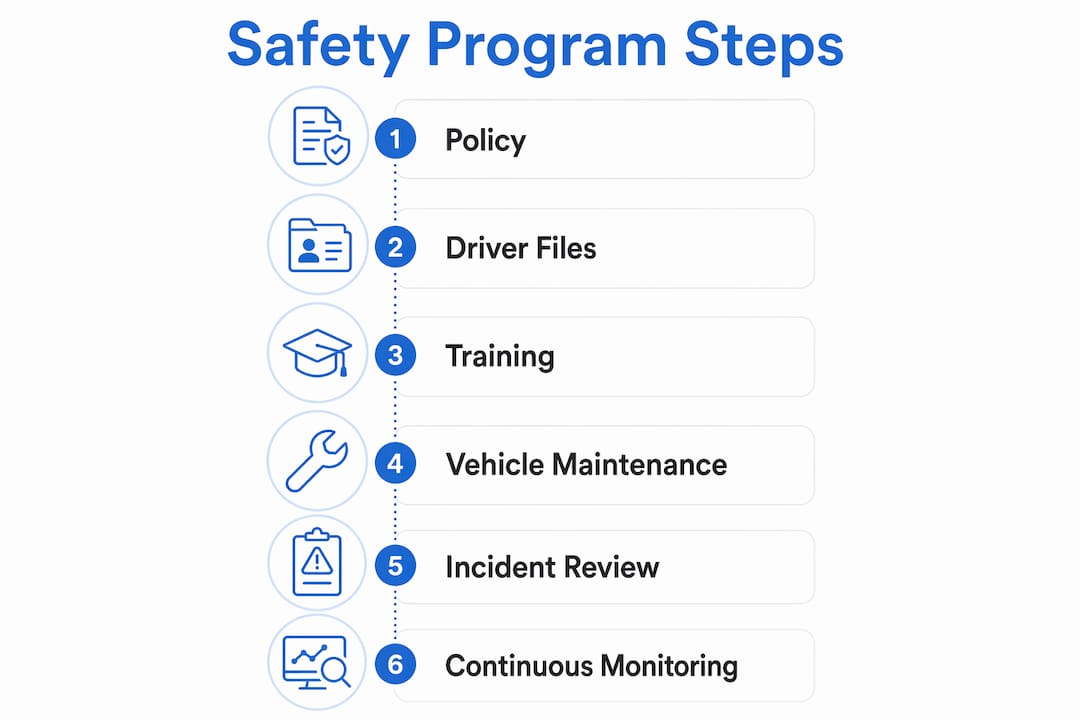
Small fleets do not need a dedicated safety department to run an effective program. You need a clear process, the right tools, and consistent follow-through. Start with these steps:
Safety technology trends show that telematics and driver monitoring now track leading indicators like harsh braking, giving you a chance to coach proactively. That breaks the reactive cycle where you only respond after something goes wrong.
Pro Tip: Schedule a 15-minute safety review at the start of each month. Review one incident, one CSA score update, and one coaching note. Small, consistent reviews build a stronger program than annual overhauls.
A trucking safety program is a living, actively managed system that reduces accidents, lowers insurance costs, and keeps your fleet FMCSA-compliant through documented policies, driver training, vehicle maintenance, and technology integration.
| Point | Details |
|---|---|
| Core program components | Every compliant program needs six elements: written policy, driver files, HOS, maintenance, drug testing, and incident investigation. |
| Financial impact | Structured programs cut accidents by 40–60% and reduce insurance premiums by 15–30% for compliant fleets. |
| Technology pays off | Dash cams and telematics cost $300–$800 upfront and recover their cost through premium discounts and avoided claims. |
| Active management is required | Insurers and FMCSA auditors want coaching logs and corrective actions, not just a policy document on a shelf. |
| Small fleets can start lean | A written policy, driver handbook, inspection logs, and one telematics device are enough to build a working foundation. |
Most small trucking companies I have seen operate with good intentions but weak documentation. The drivers are experienced. The trucks are maintained. But when an FMCSA auditor or an insurance underwriter asks for coaching logs, incident investigations, or corrective action records, the files are empty. That gap is where fleets get hurt.
The shift that changes everything is moving from reactive compliance to a proactive safety culture. That means using your telematics data every week, not just after an accident. It means investigating near-misses, not just crashes. It means your drivers know the backing safety rule because they were trained on it, not because they read it once in an orientation packet.
Technology has made this easier than it has ever been. Telematics for small fleets is no longer an enterprise-only tool. A single device per truck gives you the data you need to coach, document, and demonstrate active risk management to any underwriter who asks.
The fleets that win on insurance rates and CSA scores are not the ones with the fanciest equipment. They are the ones with consistent processes and clean records. Build the habit of documenting everything, and your program becomes your competitive advantage.
— Managment
Running a compliant safety program takes the right tools, and Goeldhub gives small fleets everything they need in one place.
Goeldhub’s ELD compliance platform supports FMCSA-compliant driver log management, HOS tracking, and vehicle inspection records at $15 per driver per month. The platform works with existing hardware including PT-30 and IOSix devices, so you do not need to replace equipment to get started. Goeldhub also connects fleets to insurance solutions designed to help you use your safety data to negotiate better rates. A 14-day free trial with no obligation gives you a risk-free way to see what a complete compliance system looks like in practice.
A trucking safety program is a structured system of written policies, driver training, vehicle maintenance, and incident investigation procedures designed to prevent accidents and maintain FMCSA compliance.
The six required components are a written safety policy, driver qualification files, Hours-of-Service management, vehicle maintenance records, drug and alcohol testing, and an incident investigation workflow.
Fleets with formal safety programs typically see 15–30% lower insurance premiums, with additional discounts of 5–10% available for specific technologies like forward collision warning and stability control.
Start with a written safety policy and driver handbook, build driver qualification files per 49 CFR Part 391, set up inspection logs, and install at least one telematics device to track driver behavior.
A CSA score is your fleet’s Compliance, Safety, Accountability rating from FMCSA. Insurers use it to set premiums, and a high score can limit your coverage options or raise your rates significantly.


.svg)