A cab card in trucking is the official registration credential issued under the International Registration Plan (IRP) that authorizes your commercial vehicle to operate legally across multiple states and Canadian provinces. If you run interstate routes as a small fleet owner or owner-operator, understanding what is cab card trucking means understanding the document that keeps your truck moving without legal interruption. The cab card is not a permit, not a license, and not optional. It is the proof of registration that enforcement officers check at roadside stops to confirm your vehicle is legally authorized to operate in the jurisdictions listed on the card.
The cab card functions as the detailed registration record for your specific commercial vehicle under the IRP system. While your apportioned plate identifies the vehicle to the public, the cab card carries the operational details that matter to law enforcement. According to the IRP Manual, apportioned plates and cab cards serve distinct roles: the plate identifies the vehicle publicly, while the cab card provides the detailed registration parameters including jurisdictions and weight classes.
Here is what the cab card contains and how it works in practice:
One point that surprises many new owner-operators: one cab card per vehicle is the rule, and that card cannot be transferred to another truck. Even in a fleet of ten trucks, each unit carries its own cab card specific to that vehicle’s registration. This matters because enforcement officers verify the card against the plate and the vehicle, not just the company name.
Pro Tip: Store the cab card in a consistent location in every truck, such as the driver-side sun visor or a document sleeve on the dashboard. Drivers who know exactly where to find it save time and avoid unnecessary tension during roadside inspections.

The original cab card must be carried in the apportioned vehicle at all times during operation. This is not a suggestion. Law enforcement treats it as mandatory proof of registration details during roadside stops, and a missing or invalid cab card can result in fines, out-of-service orders, or delays that cost you hours of drive time.
The good news for owner-operators managing paperwork: electronic cab cards have been accepted in all IRP member jurisdictions since January 1, 2019. Law enforcement officers are required to accept a digital display of the cab card on a phone or tablet. This means you can store your cab card as a PDF or image on a device and present it at a stop without carrying the paper original. The shift to digital acceptance has reduced paperwork burdens significantly for small fleets.
However, digital acceptance comes with one critical condition. Electronic cab cards require offline accessibility, meaning the file must be retrievable without a cell signal. A truck stop in rural Wyoming or a weigh station in Montana may have no data coverage. If your driver cannot pull up the cab card because the file is stored only in a cloud app requiring internet access, you face the same enforcement risk as having no card at all.
Common compliance mistakes to avoid:
For broader context on ELD compliance and how digital credentials fit into your overall regulatory picture, small fleet operators benefit from treating cab card management as part of a unified compliance system rather than a standalone task.
This is one of the most misunderstood areas in trucking registration. A cab card and a state permit are not the same thing, and confusing them can cost you money or leave you operating illegally.
| Feature | IRP Cab Card | Individual State Permit |
|---|---|---|
| Coverage | Multiple jurisdictions with one registration | Single state or single trip |
| Validity period | Annual registration cycle | Short-term, often 72 hours to 30 days |
| Cost structure | Fees apportioned by miles traveled per jurisdiction | Fixed fee per state per trip |
| Convenience | One document covers all listed states | Separate permit required per state |
| Best for | Regular interstate operations | Occasional or oversize/overweight moves |
The IRP cab card replaces the need for individual state permits when you travel across states for standard commercial operations. This is the core benefit of IRP registration. Instead of buying a permit for Illinois, then another for Indiana, then another for Ohio every time you run a load, your cab card covers all three states for the full registration year. Registration fees are apportioned among jurisdictions based on the percentage of miles you operate in each state, so you pay proportionally rather than paying full registration in every state.
Permits still apply in specific scenarios. Oversize or overweight loads that exceed standard legal limits require state-specific permits regardless of IRP status. Hazardous materials moves may require additional documentation. Single-trip operations by carriers who are not IRP-registered also require individual permits. The cab card does not replace these specialized permits. It replaces only the standard registration requirement for normal commercial vehicle operations across member jurisdictions.
Pro Tip: When you add a new state to your regular routes, contact your base jurisdiction’s IRP office to update your cab card before the first trip. Operating in a jurisdiction not listed on your cab card is a compliance violation even if you hold an apportioned plate.
Cab card management is where small trucking companies and owner-operators either stay clean or accumulate avoidable compliance problems. The document itself is simple. The discipline around it is what separates operators who sail through inspections from those who get flagged.
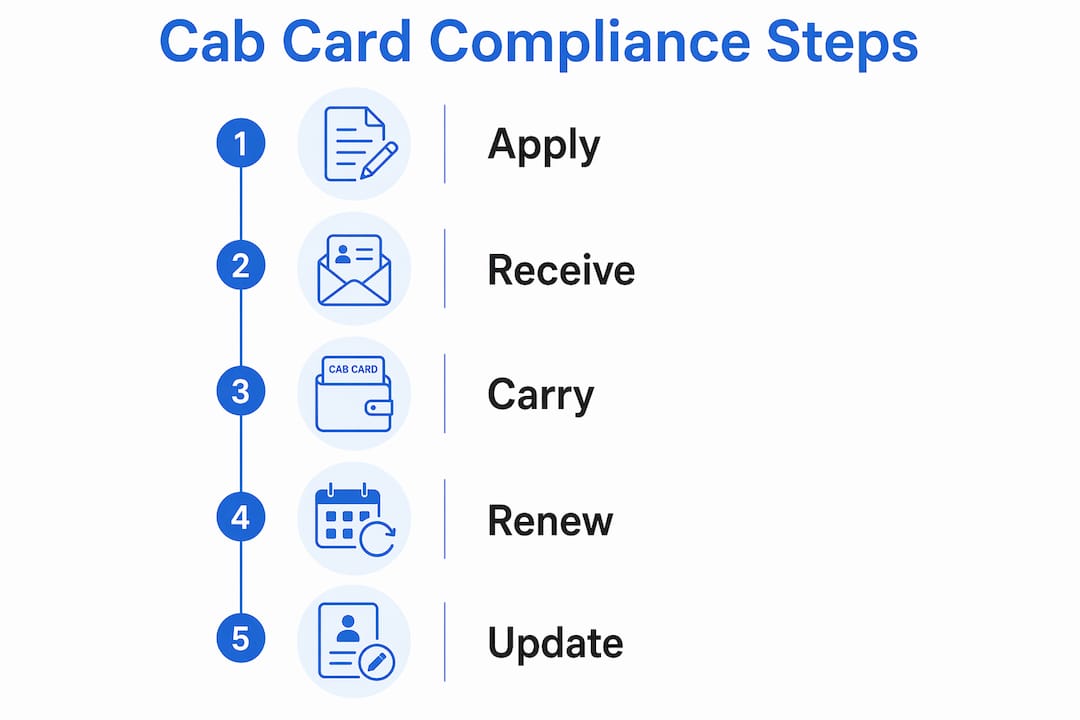
Follow these steps to keep your cab card compliance tight:
Integrating cab card management into your broader fleet compliance calendar, alongside ELD log reviews and IFTA fuel tax filings, keeps everything on one schedule rather than scattered across separate reminder systems. Platforms like Goeldhub that centralize compliance documentation make this kind of coordination practical for small operators who do not have a dedicated compliance officer.
Pro Tip: When a driver leaves your company, retrieve the cab card from the truck before the driver takes possession of any personal items. A cab card in the wrong hands is not a security risk, but a missing one during your next inspection is a real problem.
A cab card is the single most important registration document your commercial vehicle carries for interstate travel, and managing it correctly is non-negotiable for legal operation under the IRP.
| Point | Details |
|---|---|
| Cab card defined | An IRP-issued credential authorizing your vehicle to operate in listed jurisdictions with specific weight ratings. |
| One card per vehicle | Each truck in your fleet requires its own cab card; the document is vehicle-specific and non-transferable. |
| Electronic acceptance | Digital cab cards are accepted nationwide since 2019, but must be stored offline for access without cell service. |
| Cab card vs. permit | The IRP cab card covers multiple states annually; individual permits apply only to oversize, overweight, or non-IRP moves. |
| Update after changes | Any change to weight ratings, jurisdictions, or vehicle assignment must be reflected on the cab card before the next trip. |
I have worked with enough small fleet operators to know that the cab card gets treated as an afterthought until the moment it becomes a crisis. A driver gets pulled into a weigh station, the cab card is expired or missing, and suddenly a routine trip turns into a multi-hour delay and a fine that wipes out the load’s profit margin.
What I find operators consistently underestimate is how often enforcement discrepancies come not from the card being absent, but from the card being out of date. A carrier adds a new state to their routes, forgets to update the IRP registration, and runs that lane for three months before getting caught. The compliance standard is clear: operation must match what is on the cab card. That gap between actual operations and registered jurisdictions is where most small operators get hit.
The electronic cab card shift since 2019 has genuinely helped. Drivers who store their credentials on a phone are less likely to lose them than drivers carrying paper documents through months of weather and road conditions. But the offline accessibility requirement catches people off guard. I have seen drivers unable to pull up a digital cab card at a rural inspection point because the file lived in a cloud folder with no cached version. Paper backup is not outdated thinking. It is practical insurance.
My advice: treat the cab card the same way you treat your ELD device. It is a compliance tool that requires active management, not a document you file once and forget. Build the renewal and update process into your operations calendar, and you will never face a roadside surprise because of it.
— Managment

Managing cab cards, ELD logs, IFTA filings, and driver credentials across even a small fleet creates real administrative pressure. Goeldhub’s ELD compliance services are built specifically for small and mid-sized trucking companies that need FMCSA-compliant tools without the overhead of a large compliance department. For $15 per driver per month, you get access to the full platform including driver log management, fuel card programs, and operational tools that keep your fleet running clean. Goeldhub supports existing hardware including PT-30 and IOSix devices, so you do not need to replace equipment to get started. A 14-day free trial with no obligation lets you see the difference before you commit.
A cab card is the official registration document issued under the International Registration Plan that authorizes a commercial vehicle to operate in multiple jurisdictions. It lists the states and provinces where the vehicle is legally registered along with the approved weight for each.
You apply for IRP registration through your base jurisdiction’s motor vehicle or trucking authority office. Once approved, the base jurisdiction issues one apportioned plate and one cab card per vehicle.
Yes. Electronic cab cards have been legally accepted in all IRP member jurisdictions since January 1, 2019. Law enforcement must accept a digital display on a phone or tablet, but the file must be accessible offline.
A cab card covers regular commercial operations across all listed IRP jurisdictions for the full registration year. Individual state permits apply to single trips, oversize loads, or overweight moves that exceed standard legal limits.
Operating without a valid cab card during a roadside inspection can result in fines, out-of-service orders, and delays. Enforcement treats the cab card as mandatory proof of registration, and a missing or expired card carries the same consequences as operating without proper registration.


.svg)