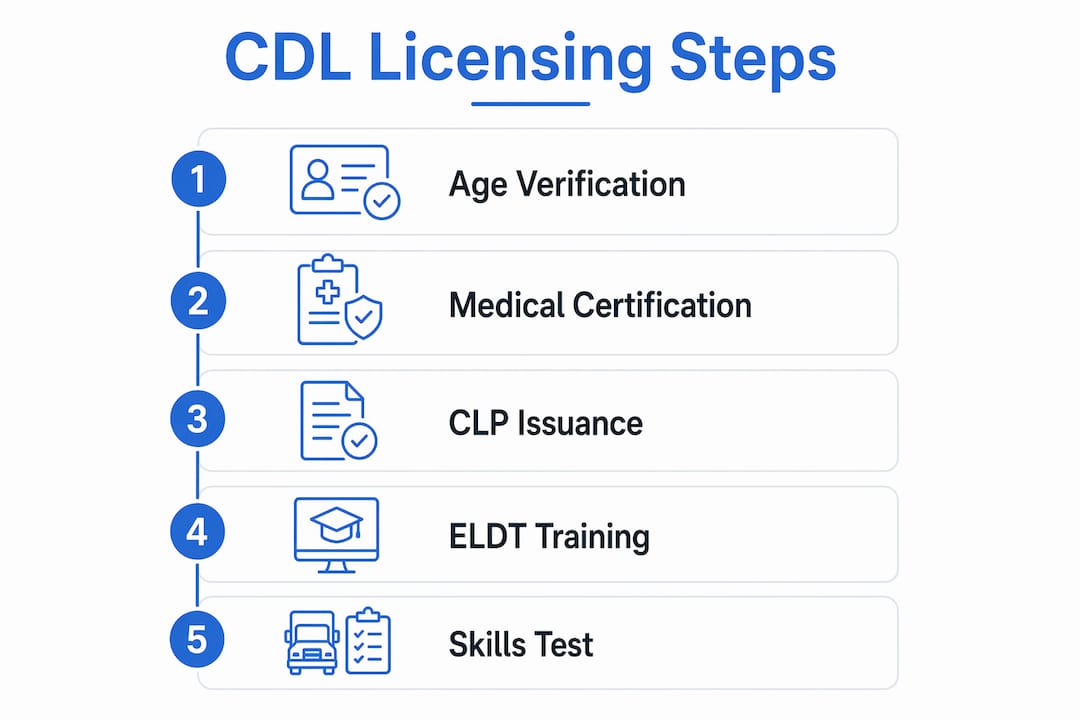
A Commercial Driver’s License (CDL) is the federally mandated credential required to legally operate large commercial vehicles in the United States. CDL requirements explained in full cover five core steps: meeting minimum age thresholds, passing a DOT medical exam, obtaining a Commercial Learner’s Permit (CLP), completing Entry-Level Driver Training (ELDT), and passing a three-part skills test. Every step is sequential. Skip one and you cannot move to the next. This guide breaks down each requirement so you know exactly what to expect before you ever set foot in a DMV.
Age is the first gate you must clear. Federal minimums set the threshold at 18 years old for intrastate driving and 21 years old for interstate or federally regulated operations. That distinction matters more than most applicants realize. If you plan to cross state lines or haul regulated cargo, you must be 21 before you can apply for an interstate CDL, regardless of your driving record or experience.
The second gate is your medical certification. FMCSA requires applicants to obtain a DOT medical examiner’s certificate, Form MCSA-5876, from a certified medical examiner listed on the FMCSA National Registry. This certificate must be current and valid at the time you apply for your CLP and throughout your skills testing. A lapsed certificate can disqualify you mid-process, which wastes both time and money.
Key medical and age eligibility criteria include:
Pro Tip: Schedule your DOT physical at least 30 days before you plan to apply for your CLP. That buffer gives you time to address any minor medical issues before your certificate is issued, so you do not face a gap in coverage during testing.
Understanding medical certificate timing is one of the most overlooked parts of the CDL process. Most applicants focus on the written test and forget that a lapse in medical certification can stop the entire process cold.
The Commercial Learner’s Permit is your legal authorization to practice driving a commercial vehicle under supervision. Getting it requires passing written knowledge tests at your state DMV. The CDL knowledge test covers general commercial driving rules, plus class-specific content depending on the license class you are pursuing. Your state’s CDL manual is the primary study resource and the direct source for test questions.

Once you have your CLP, federal law under 49 CFR 383.25 requires you to hold it for a minimum of 14 days before you can take the CDL skills test. No exceptions exist to this rule. That 14-day window is also when most applicants complete their ELDT training, so planning the overlap carefully cuts your total timeline significantly.
ELDT is a federal mandate that applies to all first-time CDL applicants who became eligible after february 7, 2022. Here is how the process works step by step:
ELDT exemptions apply only if you already held the same CDL class or endorsement before february 7, 2022. If you are upgrading to a new class or adding a new endorsement, you must complete full ELDT for that specific class or endorsement. Grandfathering is narrow and specific, not a blanket pass.
Pro Tip: Start your ELDT enrollment the same week you receive your CLP. That way, your training overlaps with the mandatory 14-day hold period, and you are ready to test as soon as both requirements are satisfied.
Choosing the wrong training provider is a costly mistake. Non-registered schools cannot submit your completion to the FMCSA Training Provider Registry, which means your state will not clear you for the skills test. Always verify your school’s registration status on the FMCSA website before enrolling. You can also explore CDL training provider alternatives to find FMCSA-compliant options near you.
The CDL skills test is a three-part exam that must be passed in full. Passing two out of three is not enough. All three components must be completed successfully to receive your CDL.
You are required to bring a representative commercial vehicle to your skills test. The vehicle must match the class of CDL you are testing for. Showing up with the wrong vehicle type results in automatic disqualification for that test date. Contact your state DMV in advance to confirm vehicle requirements for your specific class.
CDL classes define the type and weight of vehicles you are licensed to operate. Endorsements add specific permissions on top of your base license. Understanding both before you apply saves you from having to return for additional testing later.
| CDL Class | Vehicle Type | GVWR Threshold | Common Uses |
|---|---|---|---|
| Class A | Combination vehicles | 26,001+ lbs with towed unit over 10,000 lbs | Semi-trucks, tractor-trailers, flatbeds |
| Class B | Single large vehicles | 26,001+ lbs, towed unit under 10,000 lbs | Dump trucks, city buses, delivery trucks |
| Class C | Smaller vehicles with special cargo or passengers | Under 26,001 lbs | Passenger vans, hazmat vehicles, school buses |
Endorsements are add-ons that require additional knowledge tests and, in some cases, skills tests or federal background checks. Common endorsements include:
The Hazmat endorsement carries the strictest eligibility rules of any CDL credential. Felony convictions or security disqualifications can permanently bar you from obtaining it. If Hazmat transport is part of your career plan, research the TSA background check requirements before you invest in training.
Adding endorsements at the time of your initial CDL application is more efficient than returning later. Each return visit means additional fees, additional scheduling, and additional waiting. Plan your endorsement needs upfront based on the type of freight or passenger service you intend to operate.
Obtaining a CDL requires completing five sequential federal steps: age verification, DOT medical certification, CLP issuance, FMCSA-registered ELDT, and a three-part skills test.
| Point | Details |
|---|---|
| Age splits by route type | You must be 18 for intrastate and 21 for interstate or Hazmat operations. |
| Medical certificate timing matters | Your DOT certificate must stay valid from CLP application through your skills test date. |
| ELDT provider registration is critical | Only FMCSA-registered schools can submit your training completion to unlock skills test eligibility. |
| CLP hold period is non-negotiable | Federal law requires a minimum 14-day CLP hold before you can take the skills test. |
| Plan endorsements from the start | Adding endorsements at initial application saves time, fees, and repeat DMV visits. |
Most people treat the CDL process like a linear checklist and then get blindsided by the timing. The 14-day CLP hold and ELDT completion are not independent steps. They run in parallel, and if you do not start your ELDT training immediately after getting your CLP, you add unnecessary weeks to your timeline.
The other mistake I see constantly is choosing a training school based on price or proximity without checking FMCSA registration status first. A cheaper school that is not registered costs you far more in the end. Your completion record never reaches the Training Provider Registry, your state cannot verify your eligibility, and you have to repeat training at a registered provider. That is a full tuition payment wasted.
Medical certification timing is the third blind spot. Applicants schedule their DOT physical, get their certificate, and then take six weeks to prepare for the knowledge test. By the time they apply for the CLP, the certificate is close to expiring. If it lapses before your skills test, you are disqualified. Schedule your physical strategically, not just conveniently.
On endorsements: most first-time applicants underestimate how much a Hazmat or Passenger endorsement expands their job options. Carriers actively seek drivers with Hazmat credentials because fewer drivers hold them. If you are eligible and your record is clean, adding the Hazmat endorsement at the start of your career is one of the highest-return decisions you can make.
— Managment
Once you have your CDL, staying compliant is the next challenge. Goeldhub is built for exactly that.
Goeldhub provides FMCSA-compliant ELD compliance solutions that keep commercial drivers on the right side of Hours of Service regulations from their first load. The platform supports PT-30 and IOSix ELD hardware, so you do not need to buy new equipment to get started. For fleets looking to hire, Goeldhub’s CDL driver staffing services connect qualified drivers with carriers quickly. At $15 per driver per month, you get ELD compliance, fuel card discounts, factoring access, and operational tools in one place. A 14-day free trial is available with no obligation.
You must be at least 18 years old for an intrastate CDL and at least 21 years old for interstate driving or any route involving hazardous materials.
ELDT is required for all first-time CDL applicants who became eligible after february 7, 2022. Drivers who already held the same CDL class or endorsement before that date are exempt for that specific credential.
Federal law requires a minimum 14-day CLP holding period before you can take the CDL skills test. No state or circumstance waives this requirement.
The skills test has three parts: pre-trip vehicle inspection, basic vehicle controls and off-road maneuvers, and on-road driving in real traffic. You must pass all three to receive your CDL.
Certain felony convictions and security disqualifications permanently bar applicants from the Hazmat endorsement. The TSA conducts a security threat assessment on every Hazmat applicant, and U.S. citizenship or lawful permanent residency is required.


.svg)