DOT compliance in trucking is defined as the practice of meeting all federal safety regulations set by the Department of Transportation and the Federal Motor Carrier Safety Administration (FMCSA) under Title 49 of the Code of Federal Regulations (CFR). For small trucking companies, what is DOT compliance trucking comes down to one core obligation: operate legally, document everything, and be ready to prove it at any moment. The key pillars are driver qualification files, Hours of Service (HOS) logs via Electronic Logging Devices (ELDs), vehicle maintenance records, and drug and alcohol testing programs. Miss any one of these, and you risk fines, out-of-service orders, or losing broker relationships entirely.
FMCSA rules apply to all interstate commercial motor vehicles over 10,001 lbs gross vehicle weight rating (GVWR) or gross combination weight rating (GCWR). That threshold captures the vast majority of small trucking operations. The regulations are organized across several parts of 49 CFR, and each part governs a specific area of your operation.
Here are the core regulatory areas every small carrier must address:
Driver qualifications (49 CFR Part 391). Every driver must hold a valid Commercial Driver’s License (CDL) and a current medical certificate from a DOT-certified examiner. The driver qualification file must include an employment application, annual Motor Vehicle Record (MVR) review, road test results, and a signed acknowledgment of your drug and alcohol policy. These files apply to owner-operators as well as company drivers.
Hours of Service and ELD mandate (49 CFR Part 395). ELDs are mandatory for all drivers required to maintain Records of Duty Status (RODS), with limited exemptions for short-haul operations and vehicles with pre-2000 engines. Your ELD must be registered with FMCSA and capable of exporting data on demand during inspections. HOS rules cap driving time at 11 hours within a 14-hour window after 10 consecutive hours off duty.
Vehicle inspection and maintenance (49 CFR Part 396). Annual inspections by a qualified mechanic are required for every vehicle in your fleet. Drivers must complete a pre-trip and post-trip Driver Vehicle Inspection Report (DVIR) each day. Any defects noted must be repaired and signed off before the vehicle returns to service.
Drug and alcohol testing (49 CFR Part 382). You must enroll all CDL drivers in a DOT-compliant drug and alcohol testing consortium. Testing is required pre-employment, post-accident, randomly throughout the year, and upon reasonable suspicion. The FMCSA Drug and Alcohol Clearinghouse, launched in 2020, requires employers to query the database before hiring any new CDL driver.
Insurance and operating authority. Interstate carriers must register a USDOT number and obtain operating authority (MC number) through FMCSA. Minimum liability insurance levels vary by cargo type, starting at $750,000 for general freight and reaching $5,000,000 for hazardous materials. Proof of insurance must be on file with FMCSA at all times.
Understanding these DOT trucking regulations as a system, not a checklist, is what separates carriers who pass audits from those who get cited.

Missing or poorly organized records are the single largest contributor to compliance failures during DOT audits and roadside inspections. That finding should change how you think about compliance. It is not enough to have the right documents. You must be able to produce them immediately when asked.
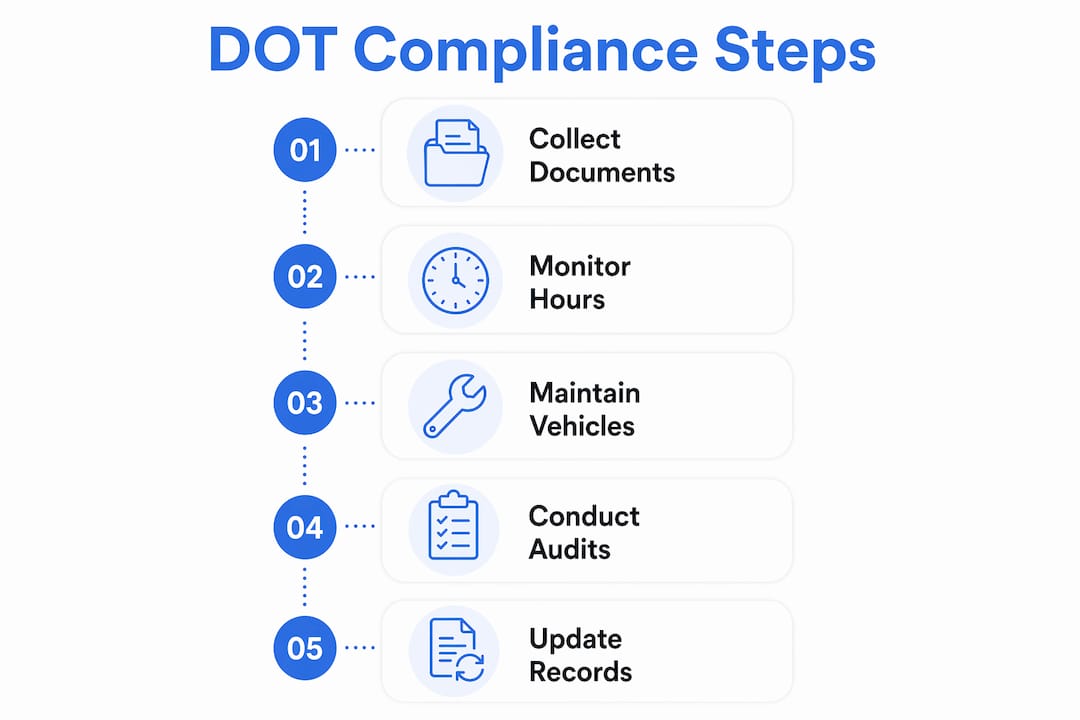
Follow these steps to build an audit-ready compliance system:
Create a driver qualification folder for each driver. Include the employment application, CDL copy, medical certificate, annual MVR, road test certificate, and drug policy acknowledgment. Update the MVR every 12 months without exception.
Organize vehicle maintenance files by unit number, not by date. Sorting by unit number allows an auditor to pull all records for a specific truck in seconds. Files sorted by date force you to search across multiple folders, which slows production and signals disorganization.
Store HOS logs and ELD data for a minimum of six months. FMCSA requires ELD data to be retained and exportable. Keep backup exports in a secure digital location separate from your primary ELD platform.
Maintain drug and alcohol testing records for at least five years for positive results and one year for negative results. Keep your Clearinghouse query records as well, since auditors will ask for them.
Conduct a self-audit every quarter. Walk through your driver files, maintenance logs, and testing records as if you were the auditor. Flag any expired certificates, missing signatures, or incomplete entries before an official inspection finds them.
DOT compliance is not only about having correct records. It is about producing them quickly and confidently. Failure to present documents immediately can result in fines even when the underlying operation is otherwise compliant. That is a costly lesson many small carriers learn the hard way.
Pro Tip: Use a digital compliance portal or ELD platform that includes expiration tracking for medical certificates and annual inspections. Automated alerts give you 30 to 60 days of lead time before a document expires, which turns a potential violation into a routine renewal.
Technology plays a growing role here. Platforms that centralize driver files, maintenance records, and HOS logs in one place cut record retrieval time from hours to minutes. For a two-truck operation or a 20-truck fleet, that efficiency gap matters during a roadside stop.
Federal FMCSA regulations set the floor for DOT trucking requirements, but many states impose stricter or supplementary rules that go beyond what Title 49 CFR mandates. This is especially true for intrastate operations, where state DOT agencies have broader authority to set their own standards.
Key areas where state rules commonly diverge from federal requirements include:
Weight and size limits. States like California and New York enforce lower axle weight limits on certain roads and bridges than federal maximums allow. Overweight permits are required for loads that exceed state thresholds even when they fall within federal limits.
Intrastate HOS rules. Some states allow intrastate carriers to operate under different HOS schedules than the federal 11-hour driving limit. Texas, for example, has historically permitted intrastate drivers to operate under a 12-hour driving rule. If you run exclusively within one state, verify whether your state DOT has adopted federal HOS rules or maintains its own version.
State registration and filing requirements. Operating near state lines triggers International Registration Plan (IRP) apportionment and International Fuel Tax Agreement (IFTA) reporting obligations. Some states also require separate state operating authority filings on top of your FMCSA registration.
Inspection and enforcement patterns. Compliance officers emphasize that enforcement intensity varies significantly by state. California’s CHP commercial vehicle enforcement unit is among the most active in the country. Carriers crossing into California should expect stricter scrutiny at weigh stations and ports of entry.
The practical takeaway is straightforward. Before you expand routes into a new state or shift from interstate to intrastate operations, contact that state’s DOT directly or consult a compliance specialist. Assuming federal rules are sufficient is one of the most common and expensive mistakes small carriers make.
Digital transformation of compliance is accelerating in 2026, with AI-enhanced ELDs, 24-hour violation reporting, and centralized compliance portals becoming standard across the industry. For small trucking companies, this shift creates both opportunity and risk.
The opportunity is real. Modern fleet compliance increasingly relies on AI and digital platforms, allowing small carriers to manage compliance proactively rather than scrambling after a violation notice arrives. Platforms now offer automated HOS alerts, real-time driver scorecard tracking, and one-click audit report generation. These tools were once accessible only to large fleets with dedicated compliance staff.
The risk is equally real. Carriers who still rely on paper logs or disconnected spreadsheets face growing exposure as enforcement agencies adopt digital verification tools that can cross-reference ELD data, Clearinghouse records, and inspection histories simultaneously. A gap that was easy to miss in a paper audit is now flagged automatically.
Here is what small fleets should prioritize in 2026:
Pro Tip: If your current ELD hardware is a PT-30 or IOSix device, you do not need to replace it to access a modern compliance platform. Some providers support existing hardware, which cuts your switching cost to near zero.
The carriers who treat compliance technology as an operating expense rather than an overhead burden will have a measurable advantage in 2026 and beyond.
DOT compliance in trucking requires maintaining accurate, organized, and immediately accessible records across driver qualifications, HOS logs, vehicle maintenance, and drug testing programs under 49 CFR.
| Point | Details |
|---|---|
| Core compliance pillars | Driver files, ELD-based HOS logs, vehicle maintenance records, and drug testing programs are all required. |
| Recordkeeping is the weak link | Missing or disorganized records cause more audit failures than actual operational violations. |
| State rules add complexity | Intrastate carriers and cross-border operators must verify state-specific requirements beyond federal FMCSA rules. |
| Digital tools are now standard | AI-enhanced ELDs and compliance portals give small fleets the same audit-readiness capability as large carriers. |
| Proactive beats reactive | Quarterly self-audits and automated expiration alerts prevent violations before they happen. |
After working closely with small trucking operations, the pattern I see most often is not willful neglect. It is the assumption that compliance is a one-time setup rather than an ongoing system. A carrier gets their USDOT number, enrolls in a drug testing consortium, installs an ELD, and considers the job done. Then 14 months later, a driver’s medical certificate expires quietly, and nobody notices until a roadside inspection.
The carriers who stay clean are not the ones with the most resources. They are the ones who treat compliance as a weekly habit rather than an annual scramble. That means someone on your team owns the compliance calendar. It means driver files get reviewed when a new document is added, not only when an auditor asks. It means your ELD data is checked for gaps every week, not every quarter.
The other mistake I see constantly is underestimating state-level rules. A carrier running exclusively in Texas or California faces a meaningfully different compliance environment than one running in the Midwest. Assuming federal rules are sufficient without checking state requirements is a shortcut that costs real money.
Embrace the technology available to you. A compliant ELD platform does not just keep you legal. It gives you the documentation to defend your operation when a broker, insurer, or auditor questions your safety record. That documentation is a business asset, not just a regulatory burden.
— Managment
Running a small fleet means compliance falls on you, your dispatcher, or whoever has time that day. Goeldhub removes that pressure with a purpose-built platform that covers every layer of DOT compliance in one place.
With Goeldhub’s ELD compliance services, your drivers log accurate HOS data on FMCSA-registered devices, and your safety manager gets real-time visibility into every log, exception, and expiration date. The platform supports existing PT-30 and IOSix hardware, so you do not need to replace equipment to get started. At $15 per driver per month, you get ELD compliance, driver log management, and audit-ready reporting without the overhead of a dedicated compliance department. Start with a 14-day free trial and see how clean records change the way you run your operation.
DOT compliance in trucking means meeting all federal safety regulations under Title 49 CFR as enforced by FMCSA, including driver qualification standards, Hours of Service rules, vehicle maintenance requirements, and drug and alcohol testing programs.
Auditors require driver qualification files, ELD-based HOS logs, vehicle inspection and maintenance records sorted by unit number, drug and alcohol testing documentation, and proof of insurance and operating authority.
ELDs are mandatory for all drivers required to maintain Records of Duty Status, with exemptions for short-haul drivers operating within a 150-air-mile radius and vehicles with engines manufactured before the year 2000.
States cannot weaken federal FMCSA rules, but they can impose stricter requirements for intrastate operations. Carriers should verify state-specific HOS rules, weight limits, and registration requirements before operating in a new state.
A quarterly self-audit is the recommended minimum. Review all driver files, maintenance logs, ELD data, and testing records every 90 days to catch expired documents or missing entries before a formal inspection does.


.svg)