A structured driver recruiting workflow is the single most effective tool fleet managers have for cutting hiring time, controlling costs, and staying FMCSA-compliant. The industry term for this process is “driver qualification workflow,” and it covers every step from initial application to a fully assembled Driver Qualification (DQ) file. A failed driver hire costs carriers approximately $16,500 when you factor in recruiting, training, insurance increases, and downtime. For small and mid-sized fleets, that number is not a rounding error. The driver recruiting workflow fleet managers need today runs mandatory DOT checks in parallel, uses digital onboarding tools, and gates candidates by compliance before wasting recruiter time.
Before you post a single job listing, your compliance infrastructure needs to be in place. The FMCSA mandates specific pre-employment checks for every CDL driver, and missing any one of them puts your fleet at audit risk. Mandatory checks include a full FMCSA Clearinghouse query, three-year Motor Vehicle Records (MVRs), safety performance history requests from prior employers, a valid medical card, and a negative DOT drug test. All records must be retained for the length of employment plus three years.
Beyond compliance documents, you need the right digital tools before recruiting starts. A mobile-friendly application platform lets drivers apply from their phones, which is where most candidates spend their time. Automated follow-up tools keep leads warm without requiring a recruiter to manually chase every applicant. A driver portal for document uploads replaces the back-and-forth of email attachments and fax machines.

The table below maps each mandatory DOT check to the digital tool category that handles it most efficiently.
| DOT Requirement | Digital Tool Category | Function |
|---|---|---|
| FMCSA Clearinghouse full query | Compliance management platform | Queries drug and alcohol violation database |
| Three-year MVR | MVR ordering service | Pulls state driving records automatically |
| Safety performance history | Employer contact tracking tool | Logs all contact attempts with date and method |
| Medical card verification | Document upload portal | Driver submits photo; system flags expiration |
| DOT drug test | Third-party lab integration | Schedules collection, returns results digitally |
Getting these tools configured before you recruit means the workflow runs without manual bottlenecks from day one.
Speed in driver hiring comes from running tasks simultaneously, not sequentially. Initiating all DOT-required checks at the same time compresses the hiring timeline from weeks to 5–7 business days. The key is collecting driver consent early so you can launch every check the moment a candidate looks qualified.
Here is the workflow that gets qualified drivers hired fast and compliantly.
Post-lead engagement quality determines hiring success more than budget or lead volume. A driver who applies on a Tuesday and does not hear back until Friday has likely already accepted another offer.
Pro Tip: Build a compliance scorecard that automatically flags non-hireable candidates based on Clearinghouse results or MVR violations. Recruiters should only spend time on candidates who pass the gate, not on chasing records for drivers who will not qualify.
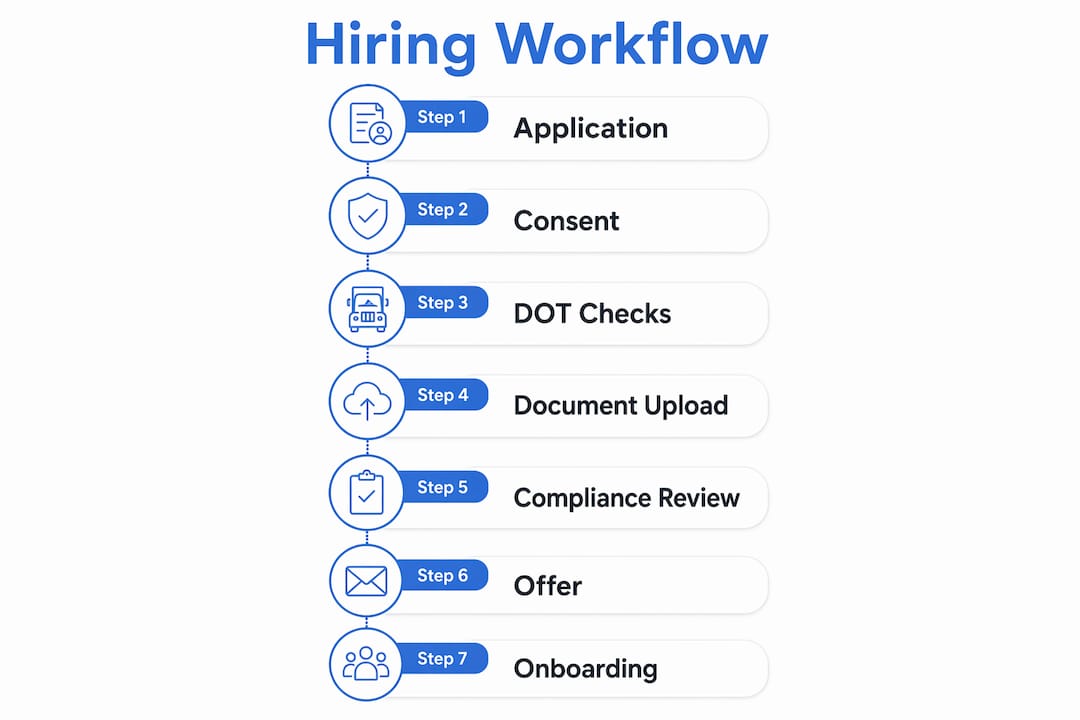
The most common delay in the fleet management hiring process is manual record chasing. Small and mid-sized fleets bottleneck hiring by manually ordering MVRs and tracking down employment history by phone and fax. Structured scorecard systems and digital ordering services eliminate most of this friction.
The five mistakes below account for the majority of compliance failures and hiring delays.
Each of these mistakes has a direct cost. Compliance audit failures can result in fines, out-of-service orders, and insurance rate increases that dwarf the cost of fixing the workflow.
Pro Tip: Set automated expiration alerts for medical cards, CDL endorsements, and drug test renewal dates. A 30-day warning gives you time to schedule renewals without pulling a driver off a load.
Digital onboarding is not a convenience feature. Mobile-friendly application platforms and automated follow-up tools improve fleet recruiting productivity by 20%–40% and reduce candidate drop-off significantly. That productivity gain translates directly into more qualified hires per recruiter per month.
The comparison below shows how traditional and digital onboarding workflows differ on the metrics that matter most.
| Workflow Element | Traditional Process | Digital Process |
|---|---|---|
| Application submission | Paper or email form | Mobile-friendly portal, under 5 minutes |
| Document collection | Fax or in-person | Driver uploads photos from phone |
| DQ file assembly | Manual, often incomplete at hire | Near-complete before first day |
| Compliance audit readiness | Reactive, gaps common | Proactive, automated alerts |
| Candidate drop-off rate | High due to slow follow-up | Reduced by automated engagement |
Remote onboarding portals that let drivers upload their CDL, medical card, and other compliance documents from their phones decrease onboarding delays and improve audit readiness. A driver who submits documents remotely arrives on day one ready to work, not ready to fill out paperwork.
Visibility dashboards give fleet managers a real-time view of which documents are pending, which have expired, and which candidates are stuck at a specific step. That visibility cuts the time recruiters spend on status checks and puts their attention on moving candidates forward. For a detailed driver onboarding strategy, the process of building a complete DQ file before arrival is one of the highest-value changes a small fleet can make.
A recruiting workflow only improves if you measure it. The right metrics tell you where candidates drop off, where compliance gaps appear, and how fast your team actually moves from application to hire.
Track these KPIs consistently.
Ongoing compliance file maintenance is not optional. DQ file retention requirements run for the length of employment plus three years. Automated document management keeps those files current without relying on a recruiter to remember every renewal date.
Driver retention connects directly to the recruiting workflow. Drivers who experience a disorganized, slow hiring process arrive with lower confidence in the company. Setting clear expectations during recruitment, communicating each step, and delivering a smooth first day builds the kind of trust that keeps drivers on your roster. For a broader look at recruiting truck drivers in 2026, the connection between hiring experience and 90-day retention is one of the most underappreciated levers in transportation workforce management.
A structured, parallelized driver recruiting workflow is the fastest way to cut hiring time, reduce compliance risk, and lower the cost of a failed hire for small and mid-sized fleets.
| Point | Details |
|---|---|
| Parallel DOT checks cut time-to-hire | Launch Clearinghouse, MVR, and safety history checks simultaneously to hire in 5–7 business days. |
| Failed hires cost $16,500 on average | Gating candidates by compliance early prevents wasted recruiter time and avoids this cost. |
| Digital onboarding boosts productivity | Mobile portals and automated follow-up improve recruiting productivity by 20%–40%. |
| Document every employer contact attempt | Undocumented attempts count as no attempt during FMCSA audits and cause compliance failures. |
| Track time-to-hire and compliance error rate | These two KPIs reveal where your workflow loses speed and where audit risk accumulates. |
Most fleet managers I talk to treat recruiting as a reactive process. A driver quits, a load goes uncovered, and suddenly everyone is scrambling. That scramble is where the $16,500 failed-hire cost lives. The fix is not a bigger recruiting budget. It is a workflow you run before you need it.
The single biggest shift I have seen is moving compliance gating to the front of the process. Fleets that screen for Clearinghouse violations and MVR disqualifiers in the first 48 hours stop burning recruiter time on candidates who will never make it to day one. That sounds obvious, but most small fleets still do it at the end, after they have already invested hours in a candidate.
Digital onboarding is the other change that pays off faster than most fleet managers expect. Drivers who can upload their CDL and medical card from their phone at 9 PM on a Sunday are more likely to complete the process than drivers who have to fax documents during business hours. That convenience is a competitive advantage when you are competing with larger carriers for the same pool of qualified drivers.
The detail that trips up the most fleets during audits is employer contact documentation. Logging every call attempt, every email, and every fax with a timestamp feels like extra work until an FMCSA auditor asks for it. Build that logging into your workflow from day one, and it becomes automatic.
Recruiting is also your first impression as an employer. A driver who experiences a clear, fast, respectful hiring process arrives with higher confidence in your operation. That confidence shows up in 90-day retention numbers. Treat the workflow as a reflection of how you run your fleet, because drivers are watching.
— Managment
Fleet managers who want to cut hiring time and stay audit-ready need more than a checklist. They need a platform that connects compliance, driver management, and operations in one place.
Goeldhub’s CDL driver services are built for small and mid-sized fleets that need recruiting support alongside FMCSA-compliant ELD management. The platform handles driver log management, document tracking, and compliance alerts so your DQ files stay current without manual oversight. Goeldhub also supports existing ELD hardware including PT-30 and IOSix devices, so you do not need to replace equipment to get started. At $15 per driver per month, you get access to the full platform plus discounted partner services for fuel, factoring, and insurance. A 14-day free trial is available with no obligation.
A driver recruiting workflow is a structured sequence of steps that takes a CDL candidate from initial application through DOT compliance checks to a signed hire decision. Running key checks in parallel compresses the process to 5–7 business days.
Mandatory pre-employment checks include a full FMCSA Clearinghouse query, three-year MVRs, safety performance history from prior employers, a valid medical card, and a negative DOT drug test. All records must be retained for the length of employment plus three years.
Launch all DOT-required checks simultaneously after obtaining driver consent. Using a driver portal for document uploads and automated follow-up tools reduces manual delays and cuts candidate drop-off rates by a significant margin.
The most common audit failure is undocumented employer contact attempts. Every call, email, or fax to a prior employer must be logged with date, time, and method, even when the employer does not respond.
Drivers who experience a fast, organized hiring process arrive with higher confidence in the company. Mobile-friendly portals and clear communication during recruitment set expectations that reduce early turnover in the first 90 days.


.svg)