Trucking cost savings are defined as measurable reductions in operating expenses achieved by targeting fuel, maintenance, driver behavior, and route efficiency. Fuel alone accounts for 20 to 30% of total operating costs for most carriers, making it the single largest controllable expense on your P&L. The examples of trucking cost savings covered here are drawn from 2026 fleet case studies and industry benchmarks, so every strategy comes with real numbers attached. Whether you run 5 trucks or 500, the same core levers apply.
Fuel optimization is the fastest path to measurable savings, and the data backs that up. Trucking operations that combined route efficiency, idle reduction, and maintenance discipline reduced fuel costs by 22 to 31%, with one 600-truck carrier saving $4.8 million annually within 90 days. That scale of return, with payback periods as short as 4.5 to 6 weeks, puts fuel optimization ahead of almost every other cost-reduction strategy.
The best practices for fuel cost management break down into four practical levers:
Pro Tip: Fuel-stop routing matters as much as the discount rate. Out-of-route miles to reach a cheaper pump can erase the per-gallon savings entirely. Route your fuel stops within your planned corridor, not around it.

Predictive maintenance is the practice of using telematics and AI diagnostics to catch component failures before they happen. AI-driven diagnostics reduce roadside failures by 45%, saving over $1 million annually in documented fleet case studies. The financial logic is straightforward: preventing a turbo bearing failure that costs $18,000 in emergency repairs requires only a $2,800 preemptive replacement.
Telematics systems can forecast 60 to 75% of major component failures before they cause downtime. That predictive window is where your savings live. Unplanned downtime costs carriers real revenue every day a truck sits idle, and the repair bill is always higher when the failure happens on the road.
Here is how a proactive maintenance program cuts costs across your fleet:
Pro Tip: Use your fleet maintenance strategies to build a component replacement calendar based on mileage thresholds, not just calendar dates. High-mileage trucks need interval-based tracking, not time-based guessing.
Driver behavior is one of the most underused cost levers in small and mid-sized fleets. Targeted coaching on speed, acceleration, and idling delivers MPG improvements without replacing a single driver. The goal is not punishment. It is data-driven feedback that gives drivers a clear picture of how their habits affect fuel costs and safety outcomes.
Video telematics and ELD systems improve driver safety and generate scorecards that reduce accident risk and support driver retention. Fewer accidents mean lower insurance premiums and reduced liability exposure. For a small fleet, even one avoided at-fault accident can save $50,000 or more in claims and rate increases.
Key behavior management tactics that deliver measurable freight cost saving results:
Route optimization is where operational discipline turns directly into dollars. AI-powered routing reduces total miles driven by 12%, saving 4.2 million miles annually in a 600-truck fleet. For a smaller operation, a 12% reduction in miles driven cuts fuel, tire wear, and driver hours simultaneously.
Deadhead miles, the miles driven without a paying load, are pure cost with zero revenue offset. Smarter routing and load matching can cut annual mileage by 15% for smaller fleets. European carriers that reduced empty kilometers by 6 to 11 percentage points recovered 38 to 65 EUR per truck per day in margin. The principle applies directly to US operations.
Pro Tip: Detention time is a hidden cost most small fleets do not track. Log every detention event and bill it consistently. If you cannot bill it, use the data to renegotiate lane rates or drop underperforming shippers.
A fuel card program is not just a discount tool. It is a data collection system that feeds your IFTA reporting, flags unauthorized purchases, and gives you per-driver visibility into fuel spend. Fuel management winners focus on operational fuel-card routing and IFTA reporting rather than chasing headline discount rates. That distinction matters because a $0.40 per gallon discount at an out-of-route stop often costs more in added miles than it saves at the pump.
The practical benefits of a structured fuel card program include:
Technology in trucking is not an upgrade. It is a defense against costs you cannot see. Telematics data reveals unauthorized fuel use and inefficient driving that can be corrected immediately once you have visibility. For small fleets operating on thin margins, that visibility is the difference between a profitable month and a break-even one.
Telematics insights for small trucking companies cover the full range of cost-saving applications, from idle alerts to maintenance forecasting. The key is integration. A telematics system that feeds data into your ELD, maintenance records, and fuel card reports gives you a complete picture of where money is leaving your operation. Disconnected tools give you fragments. Integrated platforms give you control.
ELD compliance is also a direct cost-saving measure. Accurate Hours of Service records prevent FMCSA violations that carry fines of $1,000 to $16,000 per offense. Clean records also support insurance negotiations, since carriers with documented compliance histories often qualify for lower premiums.
Not every strategy delivers the same return on the same timeline. Here is a side-by-side view of the main cost-saving levers, their typical financial impact, and how quickly you can expect results.
| Strategy | Typical savings impact | Payback period |
|---|---|---|
| Fuel optimization (idle, speed, routing) | 22 to 31% fuel cost reduction | 4.5 to 6 weeks |
| Predictive maintenance | Up to 45% fewer roadside failures | 2 to 4 months |
| Driver behavior coaching | Up to $10,769 per truck annually | 4 to 8 weeks |
| Route optimization and deadhead reduction | 12 to 15% fewer miles driven | 6 to 12 weeks |
| Fuel card and IFTA management | $0.20 to $0.51 per gallon savings | Immediate |
Small fleets with 5 to 20 trucks should prioritize fuel cards and speed discipline first. Both require minimal upfront investment and deliver returns within weeks. Mid-sized fleets with 20 to 100 trucks gain the most from predictive maintenance and telematics-based driver coaching, where the volume of data makes the ROI compound faster. The one pitfall to avoid across all strategies is treating any of these as a one-time fix. Sustained savings require ongoing monitoring, not a single implementation.
The most effective trucking cost reduction strategies combine fuel discipline, predictive maintenance, driver coaching, and route optimization into a single, data-driven operating system rather than treating each as a standalone project.
| Point | Details |
|---|---|
| Fuel is the top target | Optimizing speed, idle time, and fuel-stop routing cuts fuel costs by 22 to 31%. |
| Predictive maintenance pays fast | Catching failures early saves up to 45% of roadside breakdown costs and extends asset life. |
| Driver behavior drives savings | Speed and idle coaching can save approximately $10,769 per truck annually. |
| Route optimization cuts waste | AI routing and load matching reduce total miles by 12 to 15%, lowering fuel and labor costs. |
| Technology protects profit | Integrated telematics and ELD data reveal hidden costs and prevent compliance fines. |
Most cost-saving guides treat fuel, maintenance, and routing as separate problems. In practice, they are one problem with multiple symptoms. A driver who idles excessively also tends to accelerate harshly and skip pre-trip inspections. Fix the behavior, and you fix the fuel bill, the maintenance schedule, and the accident risk at the same time.
The fleets I have seen achieve the largest and most sustained savings share one trait: they treat cost management as a structural discipline, not a response to a bad month. They do not install telematics after a breakdown. They install it before one happens, and they use the data every week, not just when something goes wrong.
The other mistake I see constantly is chasing the biggest per-gallon fuel discount instead of optimizing the fuel network. A driver who drives 40 miles out of route to save $0.30 per gallon on a 150-gallon fill-up saves $45 and spends $60 in extra fuel to get there. The math is not complicated, but it requires someone to actually run it. That is what a good fuel card program with network routing does for you automatically.
My honest recommendation: start with the two strategies that cost the least to implement and deliver the fastest return. For most small and mid-sized fleets, that is a structured fuel card program and a speed policy enforced through telematics. Get those right, and the cash flow improvement funds everything else.
— Management
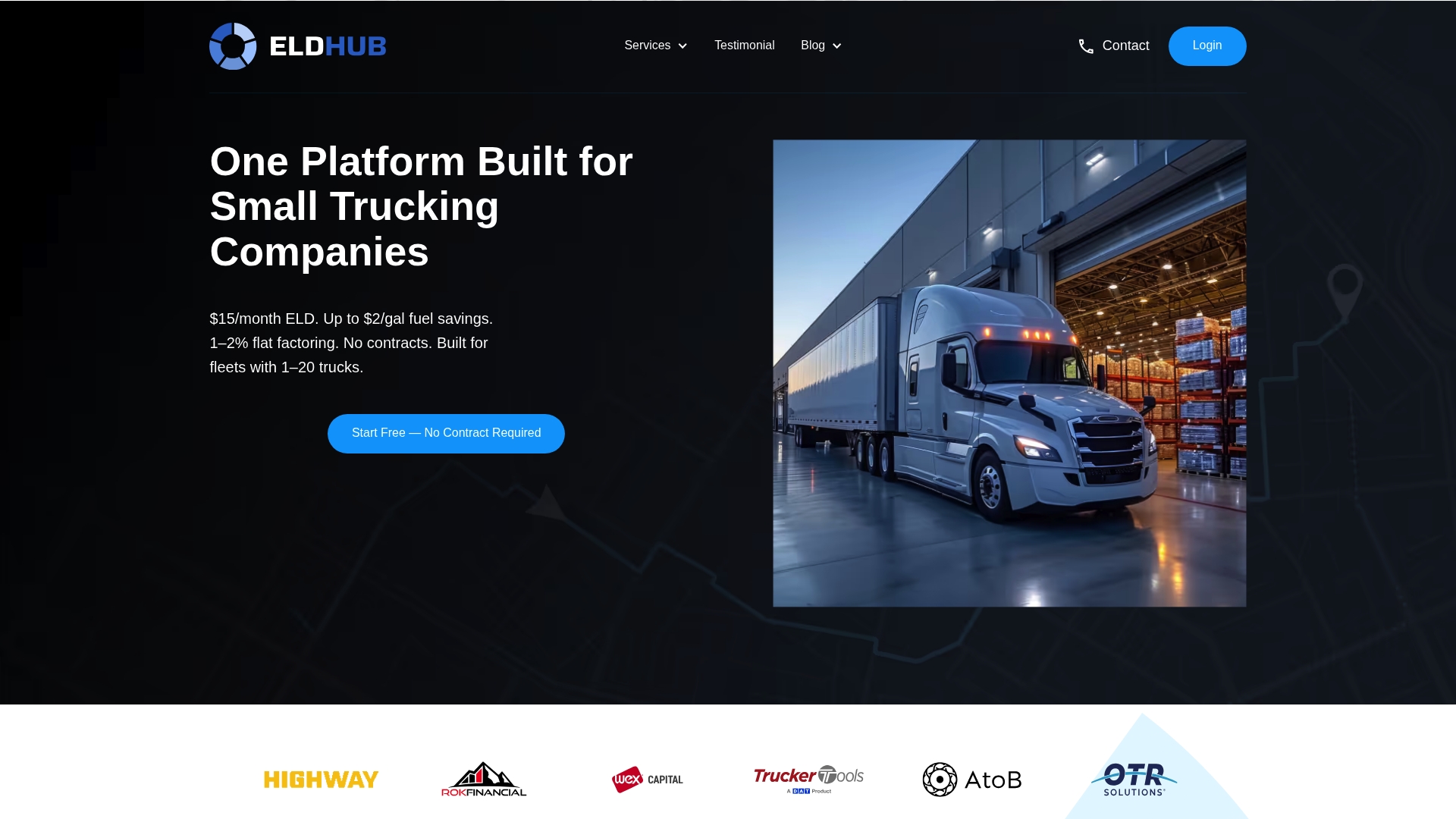
Goeldhub is built specifically for small and mid-sized trucking companies that need real cost savings without adding administrative complexity. The platform combines FMCSA-compliant ELD services with fuel card programs, driver log management, and freight rate analytics, all for $15 per driver per month. That single monthly cost covers the tools that deliver the fuel savings, maintenance visibility, and compliance protection described throughout this article.
If cash flow is the barrier to investing in cost-saving technology, Goeldhub’s factoring solutions convert outstanding invoices into working capital quickly, so you are not waiting 30 to 60 days to fund improvements. The platform supports existing ELD hardware including PT-30 and IOSix devices, so you do not need to replace equipment to get started. Try it free for 14 days with no obligation.
Fuel optimization, predictive maintenance, and driver behavior coaching are the three largest cost-saving categories. A 600-truck fleet reduced fuel costs by 31% and saved $4.8 million annually by combining all three.
Reducing highway speed from 68 to 62 MPH saves approximately $10,769 per truck annually. A structured fuel card program adds $0.20 to $0.51 per gallon in additional savings on top of that.
AI-driven diagnostics catch failing components before they cause breakdowns, reducing roadside failures by up to 45%. Replacing a turbo bearing proactively costs $2,800 versus $18,000 for an emergency roadside repair.
A fuel card program with network-based fuel-stop routing delivers immediate per-gallon savings with no upfront capital investment, making it the fastest way to reduce trucking overhead for fleets of any size.
AI-powered routing reduces total miles driven by 12%, cutting fuel, tire wear, and driver hours simultaneously. Reducing deadhead miles by 15% through smarter load matching adds further savings on every empty return run.


.svg)