Telematics in trucking is defined as an integrated system combining GPS tracking, telecommunications, and onboard diagnostics to collect and transmit real-time vehicle data for fleet management. The industry term is “vehicle telematics,” and it goes far beyond simple location tracking. Modern telematics systems pull data on engine health, driver behavior, fuel consumption, and fault codes, then send it to cloud platforms where fleet managers can act on it. Platforms like Salesforce Automotive Cloud illustrate how far this technology has matured. For small trucking companies, telematics trucking explained simply means having a continuous data feed from every truck in your fleet, giving you the visibility to cut costs, stay compliant, and prevent breakdowns before they happen.
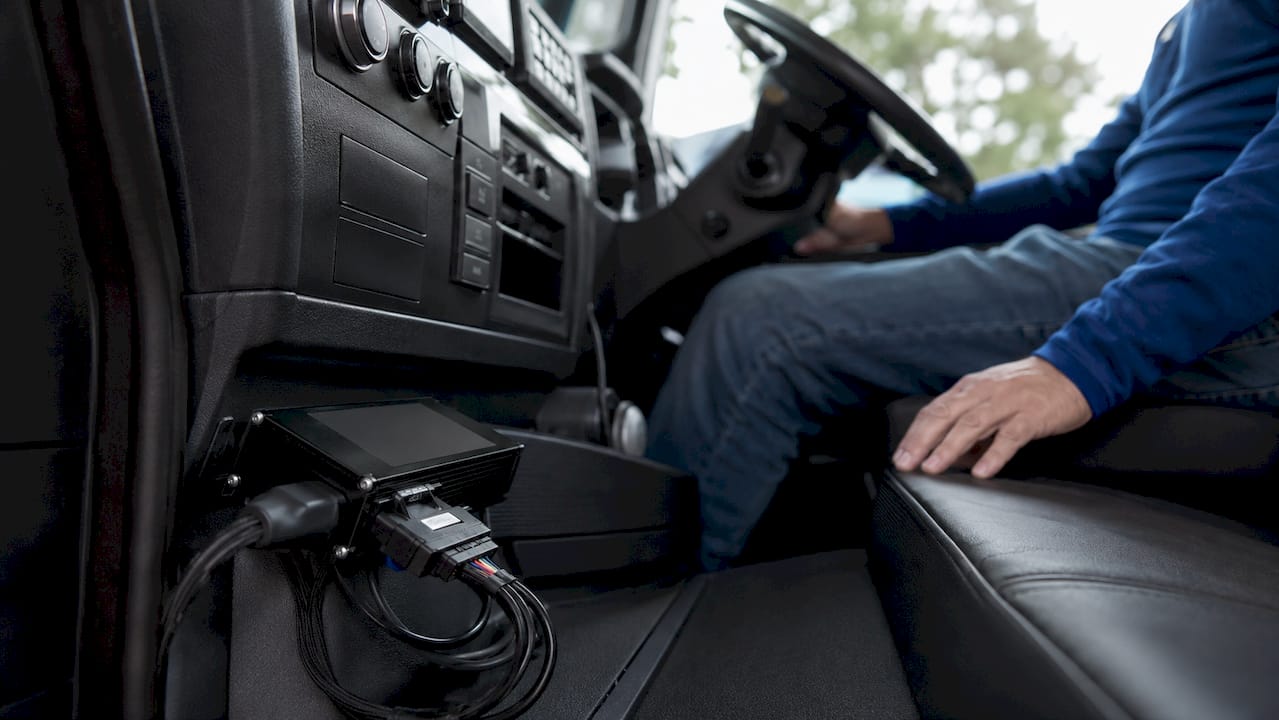
Telematics hardware sits inside your truck and does three things: it collects data, packages it, and sends it to a server you can access from any browser or app. The core components are a GPS sensor, a telematics control unit (TCU), and an OBD-II port connection that reads engine diagnostics directly from the vehicle’s computer.
Once data is collected, it travels to cloud servers via cellular or satellite networks, typically over 4G LTE or 5G. The device uses its own built-in cellular radio, so it operates independently without relying on a driver’s phone or any external connection. That independence matters because data keeps flowing whether the driver is on a call, asleep in the cab, or out of cell range on a satellite-enabled system.
The table below shows the key difference between the two main data transmission approaches:
| Feature | Passive telematics | Active telematics |
|---|---|---|
| Data transmission | Stored locally, uploaded later | Transmitted continuously in real time |
| Live tracking | No | Yes |
| Best for | Cost-sensitive, low-urgency fleets | Fleets needing real-time dispatch and alerts |
| Alert capability | None during trip | Immediate fault and behavior alerts |
Active vs. passive telematics is the most important hardware decision you will make. Active systems cost more but give you live dashboards, instant fault alerts, and real-time driver coaching. Passive systems are cheaper but leave you reacting to problems after the fact.
Pro Tip: If your fleet runs time-sensitive freight or long-haul routes, active telematics pays for itself quickly through a single prevented breakdown or avoided HOS violation.
Software platforms sit on top of the hardware and convert raw data streams into dashboards, reports, and alerts. The quality of that software layer determines how much value you actually extract from the hardware investment.
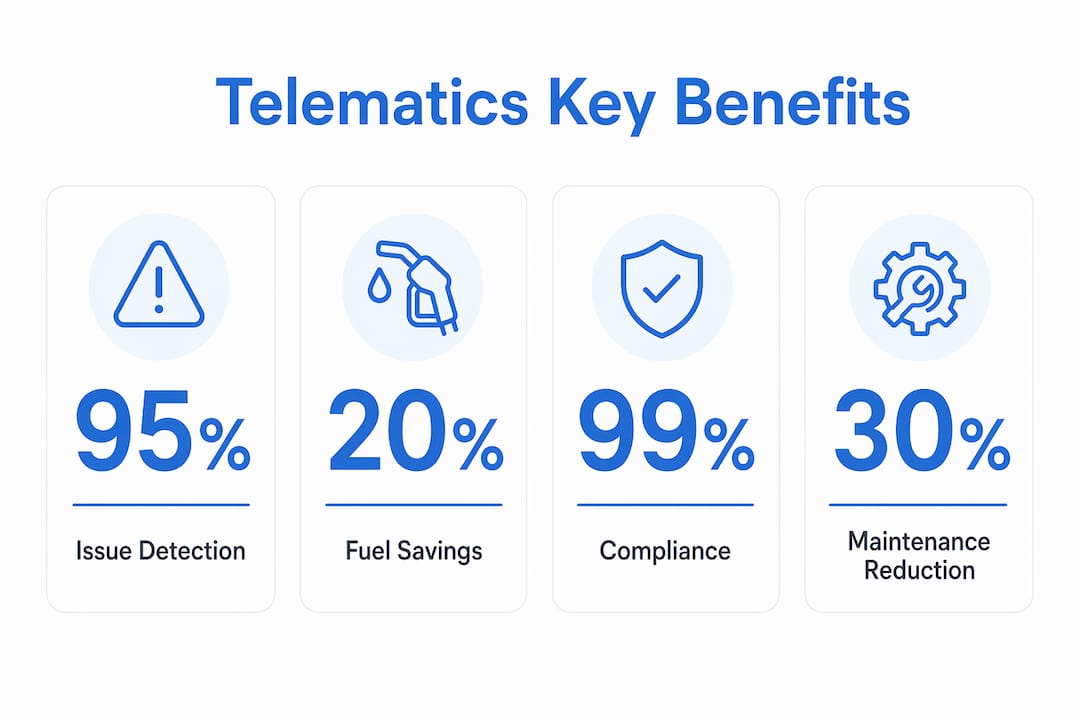
Small fleets often assume telematics is a large-fleet luxury. The global fleet telematics market is valued at over $93 billion, and entry-level systems start around $12 per vehicle per month. That price point puts real operational intelligence within reach for a two-truck owner-operator and a 20-truck regional carrier alike.
Here is what telematics delivers in practice:
Predictive telematics powered by AI can identify mechanical issues with up to 95% certainty before a breakdown occurs. Mack Trucks and Volvo Group reported that their connected services platform helped fleets avoid 115,000 downtime days. For a small fleet, even avoiding two or three unplanned roadside breakdowns per year can recover the entire annual cost of a telematics subscription.
Fuel management is another area where the numbers add up fast. Telematics data captures speed, idle time, fuel consumption, and route efficiency every few seconds to minutes. That granularity lets you pinpoint exactly which driver, route, or behavior is burning the most fuel. Pairing telematics insights with a service like mobile fuel delivery can further reduce the time and cost your drivers spend off-route at fuel stops.
The FMCSA’s ELD mandate was the single biggest driver of telematics adoption in trucking. But telematics is broader than ELD compliance. While an ELD tracks driving hours and duty status, a full telematics system adds safety scoring, maintenance alerts, and route data on top of that compliance foundation.
Here is how a small fleet can use telematics to stay compliant and audit-ready:
Pro Tip: Do not treat your ELD as a standalone compliance box. Connect it to your broader telematics platform so compliance data feeds into your maintenance and safety workflows. That integration turns a regulatory requirement into an operational asset.
For a deeper look at how ELD compliance for small fleets intersects with telematics, the regulatory picture is more connected than most owners realize.
Installation is the easy part. 66% of fleets struggle with interpreting telematics data after the hardware is in place, and 70% of fleets run multiple telematics devices simultaneously. That device sprawl creates fragmented data streams that are harder to analyze than a single unified system.
The most common barriers small fleets face include:
The solution is not more technology. It is choosing a platform that unifies your data sources and building simple workflows around the alerts that matter most. Start with three to five key performance indicators: idle time, hard braking events, fault codes, HOS compliance rate, and fuel consumption per mile. Master those before adding complexity. For more on telematics adoption for small fleets, the path from installation to real operational value follows a predictable pattern.
Choosing a telematics system is a purchasing decision with a three-to-five year operational impact. The wrong choice costs you twice: once in subscription fees and once in the operational value you never capture.
Evaluate vendors across these dimensions:
| Evaluation factor | What to look for |
|---|---|
| Hardware compatibility | OBD-II plug-and-play vs. hardwired OEM integration |
| Data transmission | Active real-time vs. passive store-and-upload |
| Software dashboard | Intuitive interface with configurable alerts and reports |
| ELD compliance | FMCSA-certified, supports HOS and DVIR |
| Integration capability | Connects to dispatch, fuel cards, and maintenance tools |
| Total cost of ownership | Hardware, monthly subscription, installation, and training |
| Scalability | Supports fleet growth without platform migration |
Evaluating telematics vendors requires balancing dashboard usability against data integration workflows. A beautiful interface that cannot connect to your dispatch software creates the same silo problem you were trying to solve.
Run a pilot with three to five trucks before committing your full fleet. Use that pilot period to test alert response times, data accuracy, and vendor support quality. Read customer reviews specifically from fleets your size, not enterprise case studies. A system built for a 500-truck carrier may overwhelm a 10-truck operation with features you will never use.
Pro Tip: Ask every vendor one specific question before signing: “Can your system integrate with my existing ELD hardware?” Platforms like Goeldhub support existing devices including PT-30 and IOSix hardware, which means you can switch platforms without replacing equipment and avoid a costly hardware refresh.
Understanding the financial impact of vehicle maintenance helps you build a realistic ROI case for telematics investment before you commit to a vendor.
Telematics in trucking delivers the most value when hardware, software, compliance data, and operational workflows are unified into a single system rather than managed as separate tools.
| Point | Details |
|---|---|
| Telematics goes beyond GPS | Modern systems combine location, engine diagnostics, driver behavior, and fuel data in one platform. |
| Active systems outperform passive | Real-time data transmission enables live alerts and immediate intervention, not just after-trip review. |
| Compliance and operations connect | Integrating ELD data with telematics turns a regulatory requirement into an uptime and safety asset. |
| Data interpretation is the real challenge | 66% of fleets struggle to act on telematics data; start with five core KPIs and build from there. |
| Small fleets can afford it | Entry-level telematics starts around $12 per vehicle per month, making ROI achievable for fleets of any size. |
I have seen small fleet owners invest in telematics hardware, watch the dashboard for two weeks, and then stop looking at it. The alerts keep firing. The data keeps accumulating. Nothing changes. That is not a technology failure. It is a workflow failure.
The fleets that get real returns from telematics share one habit: they assign ownership. Someone specific is responsible for reviewing idle time reports every Monday. Someone specific calls a driver after a hard braking event. Someone specific schedules the repair when a fault code appears. Without that ownership, telematics data is just noise.
My other observation is that simplicity wins early. The temptation is to track everything from day one. Resist it. Pick the metric that costs you the most money right now, whether that is fuel waste, unplanned repairs, or HOS violations, and build one tight workflow around it. Once that workflow runs automatically, add the next metric. Fleets that try to act on 20 data points simultaneously usually act on none of them.
Driver communication also matters more than most owners expect. When drivers understand that telematics data is used to protect them in accident disputes and to catch mechanical problems before they strand them on the highway, resistance drops significantly. Frame it as a tool for their safety, not a surveillance system, and you get better data quality because drivers stop trying to game the system.
The digital transformation in trucking technology is not about buying the most sophisticated platform. It is about building the discipline to act on what the data tells you, consistently, every week.
— Managment
If you are ready to move from understanding telematics to actually using it, Goeldhub gives small trucking companies a practical starting point. The platform covers FMCSA-compliant ELD services, driver log management, and operational tools designed specifically for fleets that cannot afford to waste time or money on systems built for enterprise carriers.
Goeldhub supports existing hardware including PT-30 and IOSix devices, so you do not need to replace equipment to get started. At $15 per driver per month, you get ELD compliance plus access to fuel card discounts, factoring support, and freight rate analytics. A 14-day free trial with no obligation lets you test the platform against your actual operations before committing. Multilingual US-based support is available when you need a real answer from someone who understands trucking.
Telematics in trucking is a system that combines GPS tracking, onboard diagnostics, and cellular or satellite communication to collect and transmit real-time vehicle data to a cloud platform. It gives fleet managers visibility into location, engine health, driver behavior, and fuel consumption from a single dashboard.
A basic GPS tracker shows where a truck is. A telematics system also shows engine fault codes, driver behavior events like hard braking, fuel consumption, idle time, and hours-of-service status. The difference is the depth of operational data, not just location.
The FMCSA ELD mandate requires electronic logging of hours of service, and most ELD devices use telematics technology to function. Full telematics beyond HOS tracking is not legally required, but it supports compliance and reduces the risk of violations and audits.
Entry-level telematics systems start around $12 per vehicle per month, making them accessible for fleets of two or more trucks. Total cost of ownership includes hardware, monthly subscriptions, installation, and any training required for your team.
Telematics systems collect GPS location, speed, idle time, fuel consumption, engine fault codes, and driver behavior events such as hard braking and rapid acceleration. Data is typically transmitted every few seconds to minutes depending on the system configuration.


.svg)