Trucking fleet management is the coordinated process of overseeing trucks, drivers, maintenance, routing, and compliance as one integrated operating system to maximize efficiency, safety, and cost control. The industry term for this discipline is “fleet operations management,” and it goes far beyond simple GPS tracking. Fleet management focuses on maximizing value from every route and mile through real-time data and analytics. For small trucking companies, understanding this system is the difference between a profitable operation and one that bleeds money through downtime, fines, and wasted fuel. This article breaks down every core component so you can run a tighter, smarter fleet.
Fleet management in trucking is the process of overseeing trucks, drivers, maintenance, fuel, routing and dispatch, and safety and compliance as a unified system to optimize utilization and control costs. It treats every vehicle as a strategic asset with measurable value, not just a piece of equipment that needs to stay on the road.
For small fleet operators running five to thirty trucks, this distinction matters enormously. Without a structured approach to fleet efficiency, you are making decisions reactively. A truck breaks down and you scramble. A driver misses a log entry and you face a fine. A route runs long and fuel costs spike. Fleet management converts those reactive moments into proactive decisions backed by data.
The core components of trucking fleet management include:
Each of these areas connects to the others. A well-maintained truck runs more efficient routes. A compliant driver avoids costly violations. A fuel card program tied to route data cuts unnecessary spend. Managing them together is what separates high-performing small fleets from those that struggle to stay profitable.
The fleet manager role is one of the most operationally demanding positions in the trucking industry. On any given day, a fleet manager handles vehicle scheduling, driver issues, compliance deadlines, and vendor relationships simultaneously. Fleet managers turn vehicles into strategic assets through operational oversight and long-term planning, with fleet management software providing centralized real-time visibility.
Here is what that looks like in practice across the major responsibility areas:
Vehicle management: Fleet managers oversee acquisition decisions, track depreciation, schedule maintenance, and plan resale timing. Buying the wrong truck for your freight type or holding a high-mileage unit too long both destroy margins.

Driver oversight: This includes recruiting qualified CDL drivers, verifying credentials, scheduling hours of service (HOS) within legal limits, and running ongoing performance reviews. Driver turnover in trucking runs high, so retention strategies are part of the job.
Operational logistics: Fleet managers coordinate routing, dispatch, and load assignments to maximize miles driven per truck per week. Dead miles, meaning miles driven without a paying load, are pure cost with no revenue offset.
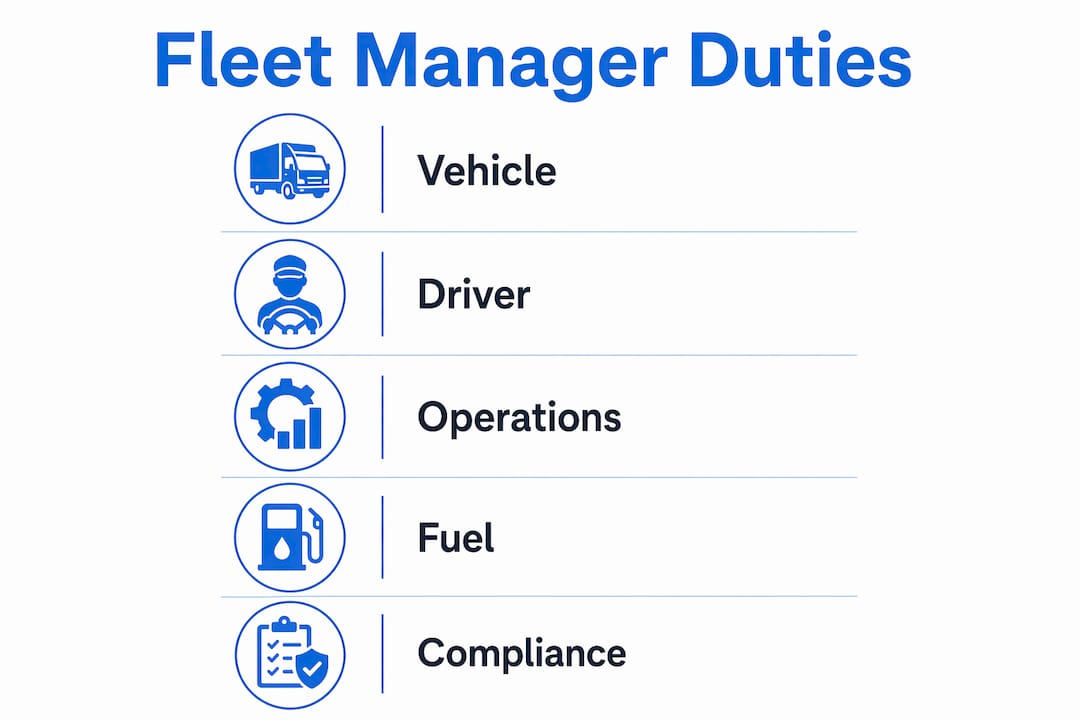
Fuel management: Fuel is typically the largest variable cost for any trucking operation. Fleet managers use fuel card programs, route optimization, and driver coaching to cut consumption and capture discounts.
Compliance oversight: This covers FMCSA regulations, ELD monitoring, drug and alcohol testing programs, vehicle inspections, and documentation management. One missed compliance step can trigger an out-of-service order or a costly audit.
Pro Tip: Use your fleet management software to set automated alerts for license expirations, medical certificate renewals, and vehicle inspection due dates. Missing these deadlines is one of the most common and most avoidable compliance failures for small fleets.
Modern fleet management software platforms centralize all of these functions. Instead of tracking driver qualifications in a spreadsheet and maintenance schedules in a notebook, you get one dashboard showing the status of every truck and driver in real time. That visibility is what allows a small fleet manager to make fast, confident decisions without dropping details.
FMCSA compliance is not optional, and the penalties for violations are steep. Maximum civil penalties reach $16,550 per violation in 2026 under the 49 CFR regulatory framework covering driver qualification, hours of service, drug testing, vehicle inspection, and hazardous materials rules. A single audit with multiple findings can cost a small fleet more than a truck payment.
The regulatory framework small fleets must manage includes:
| Regulation area | Key requirement | Risk of non-compliance |
|---|---|---|
| Driver qualification (49 CFR Part 391) | Valid CDL, medical certificate, MVR review | Out-of-service, fines, liability |
| Hours of service (49 CFR Part 395) | ELD-recorded HOS logs, 11-hour driving limit | Violations, driver OOS orders |
| Vehicle inspection (49 CFR Part 396) | Pre- and post-trip DVIRs, annual inspections | Equipment OOS, audit findings |
| Drug and alcohol testing (49 CFR Part 382) | Pre-employment, random, and post-accident testing | Driver disqualification, fines |
| Hazardous materials (49 CFR Part 397) | Placarding, routing, and documentation rules | Criminal penalties, DOT action |
The ELD mandate adds another layer of operational complexity. ELD compliance requires a full workflow covering device selection, installation verification, driver training, malfunction response, log review, and records retention. Buying a registered ELD device is only the first step. Fleets that treat ELD compliance as a hardware purchase rather than an operational program consistently fail audits.
DOT safety audits examine fleet operations using FMCSA’s six-factor criteria. Digital management of driver qualification files, HOS logs, and DVIRs significantly improves audit readiness. Auditors treat paper-based records with far more scrutiny, and gaps in paper logs are nearly impossible to explain away. Small fleets relying on paper face massive operational hurdles when an auditor walks through the door.
Pro Tip: Run an internal pre-audit review every quarter. Pull a sample of driver logs, check for HOS consistency, verify medical certificates are current, and confirm DVIR records match maintenance work orders. Catching your own gaps before an auditor does is far less expensive.
The practical compliance strategy for small fleets comes down to three things: digital records, consistent processes, and regular internal reviews. ELD compliance for small fleets requires treating every log entry, inspection record, and qualification document as audit evidence, because that is exactly how FMCSA treats it.
Unplanned breakdowns are the most expensive events in fleet operations. A truck sitting on the side of the road costs you the repair bill, the tow, the missed load, and the driver’s downtime. Predictive, preventive, and mobile repair maintenance form a three-pronged strategy to reduce breakdowns, cut repair costs, and increase uptime.
Here is how each approach works and when to use it:
| Maintenance type | How it works | Best use case |
|---|---|---|
| Preventive | Scheduled service triggered by mileage, engine hours, calendar, or condition | Oil changes, tire rotations, brake inspections |
| Predictive | Telematics and sensor data flag issues before failure | Engine fault codes, brake wear sensors, tire pressure monitoring |
| Mobile repair | Technician dispatched to truck location for onsite fixes | Minor repairs, tire changes, roadside breakdowns |
Preventive maintenance programs use multi-trigger logic to optimize service timing and avoid both over-servicing and under-servicing. A truck running long-haul routes accumulates engine hours faster than mileage would suggest, so a calendar-only schedule misses the actual wear cycle. Multi-trigger logic catches that gap.
Driver Vehicle Inspection Reports (DVIRs) are the front line of your maintenance program. When drivers complete DVIRs consistently and those reports feed directly into work order creation, you catch defects before they become failures. Fleets that treat DVIRs as a paperwork formality rather than a maintenance input miss the most cost-effective early warning system available to them.
The financial impact of vehicle maintenance compounds over time. A fleet that runs a disciplined preventive program spends more on scheduled service but dramatically less on emergency repairs, towing, and lost revenue from unplanned downtime. The math consistently favors prevention over reaction.
Pro Tip: Set maintenance alerts to trigger work orders 10% before the service threshold, not at the threshold itself. If your oil change interval is 15,000 miles, create the work order at 13,500 miles. This gives you scheduling flexibility and prevents cluster breakdowns when multiple trucks hit their service dates simultaneously.
Reliability in fleet maintenance comes from combining all three strategies rather than relying on any single approach. Predictive data tells you what is about to fail. Preventive schedules keep routine wear in check. Mobile repair minimizes downtime when something does go wrong despite your best planning.
Fleet management software centralizes vehicle tracking, maintenance scheduling, driver management, compliance reporting, and fuel monitoring into one platform. This replaces the spreadsheets, paper logs, and disconnected systems that most small fleets start with and never fully escape.
The core features that matter most for small trucking operations include:
Modern platforms integrate telematics, fuel card data, routing, and automated driver coaching to improve fuel management and overall fleet performance. The practical result is that a fleet manager running twenty trucks can monitor the entire operation from one screen rather than making phone calls and chasing paper.
The automation piece is where small fleets gain the most ground. When a driver’s medical certificate is about to expire, the system flags it. When a truck hits its service mileage, a work order generates automatically. When an HOS violation is approaching, the driver gets an alert. These automated catches replace the manual oversight that small fleet managers simply do not have time to perform consistently.
Goeldhub supports existing ELD hardware including PT-30 and IOSix devices, so you do not need to replace equipment to get these capabilities. At $15 per driver per month, the platform gives small fleets access to compliance tools, fuel card programs, and operational analytics that were previously available only to large carriers.
Effective trucking fleet management requires integrating compliance, maintenance, driver oversight, and technology into one coordinated system rather than managing each area in isolation.
| Point | Details |
|---|---|
| Fleet management is a system | Trucks, drivers, compliance, and maintenance must be managed together to control costs and maximize uptime. |
| FMCSA penalties are significant | Civil penalties reach $16,550 per violation in 2026, making proactive compliance non-negotiable for small fleets. |
| Maintenance strategy drives profitability | Combining predictive, preventive, and mobile repair approaches cuts emergency repair costs and reduces unplanned downtime. |
| ELD compliance is a workflow | Buying an ELD device is not enough. Driver training, log review, and records retention are all required components. |
| Software replaces fragmented systems | Fleet management platforms centralize tracking, compliance, maintenance, and fuel data to reduce manual overhead and improve decisions. |
After working closely with small trucking operations, the pattern I see most often is this: fleet managers know the rules but underestimate the documentation. They know drivers need medical certificates. They know trucks need inspections. What catches them in audits is not ignorance of the regulation. It is the missing record that proves they followed it.
The second pattern is treating technology as a cost rather than a control mechanism. A fleet manager running fifteen trucks on spreadsheets is not saving money on software. They are spending that money on errors, missed deadlines, and reactive decisions that cost far more than any platform subscription.
The third thing I have observed is that driver communication is underrated as a compliance tool. Drivers who understand why HOS rules exist, why DVIRs matter, and how their logs affect the company’s safety score are far more likely to complete records accurately. Training is not a one-time event. It is an ongoing conversation.
My honest recommendation for any small fleet owner reading this: start with compliance, then build your maintenance program, then layer in software to connect both. Trying to implement everything at once creates confusion. Getting your compliance house in order first gives you a stable foundation to build on.
— Management
Running a small fleet means wearing every hat at once. Goeldhub takes the compliance and operational weight off your plate with an all-in-one platform built specifically for small and mid-sized carriers.
With Goeldhub’s ELD compliance services, you get FMCSA-compliant ELD management, driver log oversight, automated alerts, and audit-ready record storage. The platform supports PT-30 and IOSix hardware, so you can switch without replacing equipment. At $15 per driver per month, you also unlock fuel card discounts, low-fee factoring, freight rate analytics, and insurance assistance. If you need qualified drivers, Goeldhub’s CDL driver services connect you with vetted candidates ready to work. Start with a 14-day free trial and see what a fully integrated fleet operation feels like.
Trucking fleet management is the integrated oversight of trucks, drivers, maintenance, fuel, routing, and compliance to maximize operational efficiency and control costs. It treats every vehicle as a strategic asset rather than just equipment.
Small fleets must comply with 49 CFR parts covering driver qualification, hours of service, vehicle inspection, drug and alcohol testing, and hazardous materials. Civil penalties for violations can reach $16,550 per violation in 2026.
The FMCSA ELD mandate requires nearly all CMV drivers who maintain records of duty status to use a registered ELD device. Compliance requires driver training, malfunction response procedures, log review, and records retention, not just hardware installation.
Combining predictive maintenance using telematics data, preventive maintenance using multi-trigger schedules, and mobile repair for roadside issues produces the lowest total maintenance cost and highest uptime for small trucking fleets.
Fleet management software centralizes GPS tracking, compliance documents, maintenance scheduling, driver logs, and fuel monitoring into one platform. This replaces disconnected manual systems and reduces the administrative burden on small fleet managers.


.svg)