The driver onboarding process in trucking is the structured sequence of steps fleets use to equip new drivers with the documentation, training, and support needed for safe, compliant operation from day one. Done right, it is your single most effective tool for cutting early turnover and staying on the right side of FMCSA regulations. Structured onboarding programs reduce first-year driver turnover by up to 30%. That number matters because approximately 35% of new drivers quit within the first 90 days, costing fleets between $136,000 and $360,000 per 50 hires. For small fleets without dedicated HR teams, a clear, repeatable process is not optional. It is the difference between a driver who stays and one who quits before the second paycheck.

A complete new driver orientation follows a logical sequence. Each phase builds on the last, and skipping any step creates gaps that show up later as compliance violations or early resignations. Small fleets can use a 7-step onboarding framework that takes 3–5 business days before a driver is dispatch-ready.
Pre-arrival screening. Run a full DOT compliance check before the driver sets foot in your office. This includes pulling the motor vehicle record, verifying the commercial driver’s license, confirming medical certification, and completing a pre-employment drug test. DOT Clearinghouse pre-employment queries are mandatory before a driver’s first dispatch and annually after that. Missing this step can cost your fleet up to $6,875 per violation.
Driver qualification file setup. Build the DQF on Day 1. Required documents include the employment application, road test certificate, prior employer verification, and drug and alcohol testing records. Missing documents in driver qualification files can trigger costly DOT penalties and hurt your compliance audit score.
Safety and policy orientation. Cover your fleet’s safety policies, hours-of-service rules, and ELD operation. Leading fleets provide 16–24 hours of orientation for experienced drivers and 40–60 hours for entry-level drivers. That range reflects the real difference in knowledge gaps between a 10-year veteran and a recent CDL graduate.
Vehicle familiarization and road assessment. Walk the driver through your specific equipment before any road test. Every truck has quirks. A driver who knows your truck’s braking feel and blind spots is safer on day one than one who figures it out on the highway.
Dispatch and route training. Introduce your dispatch system, load board access, and communication expectations. Show the driver how to reach you, how loads are assigned, and what the check-in schedule looks like.
Pay structure walkthrough. Show a sample settlement statement during orientation. Pay discrepancies are the top driver complaint in the first 90 days. Showing exactly how mileage pay, fuel surcharges, and deductions work removes the guesswork before it becomes a grievance.
30-60-90 day check-ins. Schedule formal reviews at each milestone. Ask direct questions: Is the equipment working? Are loads matching what was promised? Are there dispatch communication issues? These check-ins catch problems before they become resignations.
Pro Tip: Assign one point of contact, such as a dispatcher or fleet manager, to each new driver for the first 90 days. Drivers who know exactly who to call when something goes wrong are far less likely to quit out of frustration.
The first 90 days are the most dangerous window for driver attrition. Failed pay promises, poor communication, and equipment issues are the three leading causes of early resignation. Each of those problems is preventable with a structured process.
“Consistent communication and fulfilling promises during onboarding directly impact driver retention.” The fleets that hold onto drivers are the ones that do what they said they would do, starting on Day 1.
Pay clarity is the fastest win. A driver who understands exactly how their settlement is calculated will not spend their first week second-guessing whether they made the right move. Equipment readiness is equally critical. Drivers are likely to doubt their decision if equipment is not ready or ELD systems are not configured at the start of orientation. That doubt compounds fast. A driver who spends Day 1 waiting for a working ELD is already mentally halfway out the door.
Safety outcomes also improve with structured trucking driver training. Drivers who complete a full orientation covering safety policies, ELD and HOS training, and hands-on vehicle familiarization enter the road with fewer knowledge gaps. Fewer knowledge gaps mean fewer preventable crashes. For small fleets, one at-fault accident can wipe out months of profit and spike your insurance premiums. You can read more about protecting your fleet in this trucking fleet safety guide.
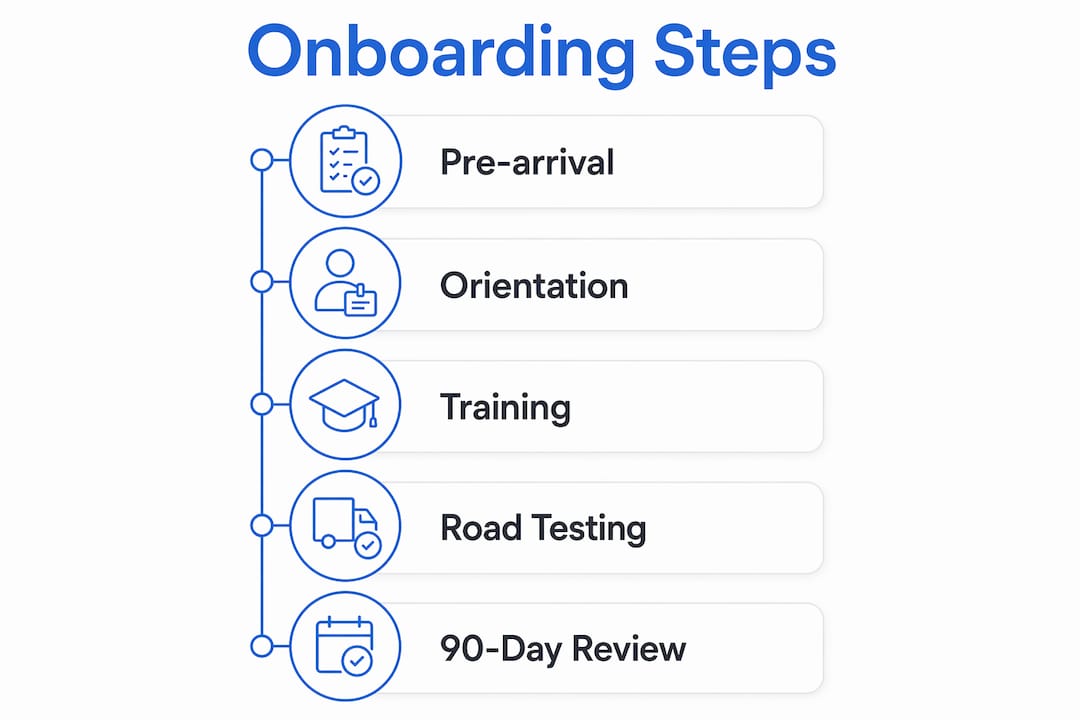
Most onboarding failures come down to the same handful of mistakes. Knowing them in advance lets you build a process that avoids them entirely.
Pro Tip: Build a simple shared folder or digital file for each driver that includes their DQF documents, orientation sign-offs, and check-in notes. You do not need expensive HR software. A well-organized Google Drive folder works fine for a 5-truck fleet.
For a deeper look at staying audit-ready, the DOT compliance guide for small fleets covers the regulatory requirements that intersect directly with your onboarding program.
A complete trucking onboarding checklist divides the process into four phases, each with clear ownership and documentation requirements.
| Phase | Key Tasks | Owner |
|---|---|---|
| Pre-arrival | MVR pull, CDL verification, drug test, Clearinghouse query | Fleet manager |
| Day 1 | DQF setup, policy review, ELD training, pay walkthrough | Fleet manager or dispatcher |
| Week 1 | Road assessment, route training, first-load support call | Dispatcher |
| Milestone reviews | 30, 60, and 90-day check-ins with documented notes | Fleet manager |
Each phase needs a named owner. Without ownership, tasks fall through the cracks. The pre-arrival phase is the most commonly skipped because it happens before the driver is physically present. Build it into your recruitment workflow so it runs in parallel with the job offer.
Digital documentation makes the process faster and audit-proof. Store DQFs in a cloud folder with subfolders for each driver. Name files consistently, for example: “Smith_J_DrugTest_2026-03” so you can find anything in seconds during a DOT audit. For ELD compliance and driver log management, digital tools remove the manual burden and keep records accurate from the first day a driver logs hours.
Training modules do not need to be elaborate. A short video walkthrough of your ELD device, a printed HOS reference card, and a route map for the first three lanes your driver will run cover the basics. Pair those with a signed acknowledgment form and you have documentation that the training happened. That documentation protects you in a compliance audit and in any future dispute with a driver.
Tracking progress through the 90-day window is straightforward with a simple spreadsheet. List each driver, their hire date, and checkboxes for each phase completion. Review it weekly. If a driver hits the 30-day mark without a formal check-in, that is a flag to act on immediately.
A structured driver onboarding process is the most direct way small trucking fleets can cut early turnover, stay compliant, and build a reliable driver base.
| Point | Details |
|---|---|
| First 90 days are critical | Approximately 35% of new drivers quit in this window, costing fleets up to $360,000 per 50 hires. |
| DOT Clearinghouse is mandatory | Run pre-employment queries before first dispatch or face fines up to $6,875 per violation. |
| Pay clarity prevents early exits | Show a sample settlement statement during orientation to eliminate pay-related complaints. |
| Equipment readiness builds trust | Have the truck fueled and ELD configured before the driver arrives on Day 1. |
| Milestone check-ins retain drivers | Scheduled 30, 60, and 90-day reviews catch problems before they become resignations. |
Most fleet managers treat onboarding as a compliance exercise. Get the paperwork signed, run the drug test, hand over the keys. That mindset is exactly why so many small fleets lose drivers in the first month.
The fleets I have seen retain drivers consistently treat onboarding as the first chapter of a working relationship. They show up prepared. The truck is ready. The ELD is configured. The dispatcher already knows the driver’s name. That level of operational readiness communicates something no policy manual can: “We were expecting you, and we are glad you are here.”
The human connection piece is underrated. A five-minute call from the dispatcher after a driver’s first load does more for retention than any bonus program. Drivers want to know someone is paying attention. Small fleets actually have an advantage here over large carriers. You can offer that personal contact in a way a 2,000-truck operation simply cannot.
The other thing I would push back on is the idea that small fleets cannot afford a real onboarding program. You do not need an HR department. You need a checklist, a shared folder, and a dispatcher who makes two extra calls per week during a driver’s first month. That is it. The cost is almost zero. The return is a driver who stays past 90 days and becomes a reliable part of your operation.
— Managment
Running a tight onboarding program means your compliance tools need to be ready before the driver is. Goeldhub’s ELD compliance platform gives small fleets FMCSA-compliant driver log management from Day 1, so new drivers start logging hours correctly without a steep learning curve.
Goeldhub supports existing hardware including PT-30 and IOSix devices, so you do not need to replace equipment when you bring on new drivers. The platform also includes driver recruiting support, making it easier to connect with qualified CDL drivers who are ready to work. At $15 per driver per month, it covers ELD compliance, fuel card discounts, and operational tools in one place. A 14-day free trial with no obligation lets you test the full platform before committing.
The driver onboarding process in trucking is the structured sequence of steps that prepares a new driver for safe, compliant, and productive operation. It covers pre-arrival screening, documentation, orientation, training, and milestone check-ins.
A complete onboarding process takes 3–5 business days before a driver is dispatch-ready. Experienced drivers typically receive 16–24 hours of orientation, while entry-level drivers require 40–60 hours.
Ask about prior employer experience, familiarity with ELD devices, preferred home-time schedule, and any concerns about pay structure. These questions surface potential issues early and set clear expectations on both sides.
Failed pay promises, poor communication, and equipment that is not ready are the top three causes of early resignation. Proactive dispatcher contact and pay clarity during orientation reduce attrition significantly during this window.
A driver qualification file must include the employment application, CDL copy, motor vehicle record, road test certificate, prior employer verification, and drug and alcohol testing records. Missing any of these documents can result in DOT penalties during a compliance audit.


.svg)