Primary liability insurance trucking is defined as the mandatory commercial coverage that pays third-party bodily injury and property damage claims when your truck causes an accident. The Federal Motor Carrier Safety Administration (FMCSA) requires proof of this coverage before granting or maintaining operating authority. Without it, you cannot legally haul freight. The formal industry term is “trucking auto liability” or “commercial auto liability,” though carriers and brokers commonly call it primary liability. This guide covers the FMCSA filing requirements, what the coverage actually pays for, what it does not pay for, how premiums are calculated, and the compliance mistakes that get small carriers shut down.
The federal minimum financial responsibility for most interstate, for-hire general freight carriers is $750,000 per occurrence under 49 CFR Part 387. That number rises to $1,000,000 for carriers hauling certain non-hazardous oil and $5,000,000 for hazardous materials. These are not suggestions. FMCSA will not activate or maintain your operating authority without the correct minimum on file.
The filing mechanism matters as much as the coverage itself. FMCSA requires your insurer to submit proof directly using specific forms, not just a certificate of insurance (COI). A COI is a document between you and your insurer. It means nothing to FMCSA unless the insurer also submits the correct filing. The two primary forms are:
Pro Tip: After any policy change, renewal, or insurer switch, log into the FMCSA Licensing and Insurance (L&I) system directly to confirm your filing shows as active. Do not rely on your insurer or agent telling you it is done.
Matching the correct filing forms to your authority type and cargo class is one of the most frequent compliance failures among small carriers. Getting this right from day one saves you from authority gaps that cost you freight contracts.

Primary liability covers third-party bodily injury and property damage caused by your truck when you are at fault. If your driver rear-ends a passenger vehicle and injures the occupants, your primary liability policy pays their medical bills, lost wages, and property repair up to your policy limit. That is the core function.
What it does not cover is equally important to understand. Primary liability is not a full protection package on its own.
| Coverage Type | What It Pays For | Included in Primary Liability? |
|---|---|---|
| Third-party bodily injury | Medical bills, lost wages for injured parties | Yes |
| Third-party property damage | Repairs to other vehicles or structures | Yes |
| Your truck (physical damage) | Collision and comprehensive repairs to your rig | No |
| Cargo loss or damage | Freight you are hauling | No |
| Driver injury | Medical costs for your own driver | No |
| Excess liability | Claims above your primary limit | No |
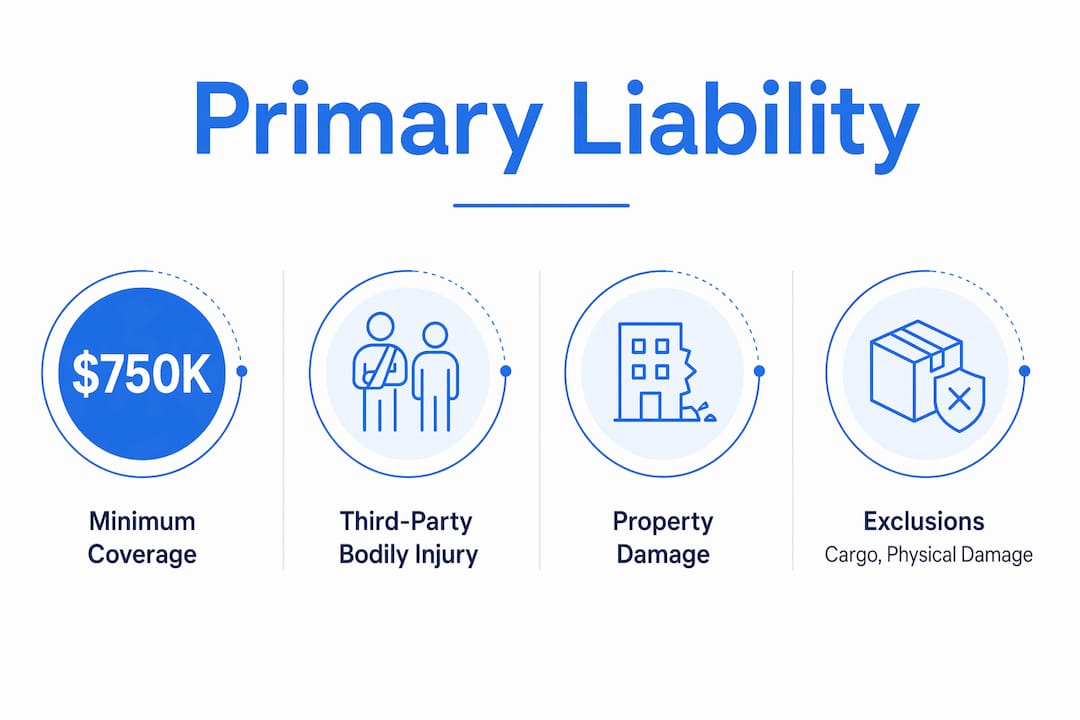
To build complete commercial trucking coverage, most carriers add physical damage, motor truck cargo, and occupational accident policies alongside their primary liability. Workers compensation applies if you have employees rather than owner-operators.
The Combined Single Limit (CSL) is the standard structure for trucking liability. A $1M CSL means the policy pays up to $1,000,000 total per occurrence across both bodily injury and property damage combined. Brokers and shippers commonly require $1M CSL as a minimum for freight tender, even though the FMCSA legal floor is $750K for general freight. That gap between the legal minimum and the practical market minimum catches new carriers off guard.
Pro Tip: Read every broker packet before signing. Many national brokers require $1M primary plus a $1M excess layer, totaling $2M in coverage. If your policy only hits $1M, you will be disqualified from those loads before you ever submit a rate.
Primary liability premiums for owner-operators typically run $8,000 to $18,000 annually for $1M CSL coverage. That is a wide range, and every dollar of the difference comes down to measurable risk factors. Insurance underwriters price your policy based on how likely you are to file a claim and how large that claim might be.
The main cost drivers are:
Insurance cost can represent 4–8% of trucking revenue for owner-operators. That benchmark helps you build a realistic operating budget. If your annual revenue is $150,000, plan for $6,000–$12,000 in liability insurance alone before adding physical damage and cargo coverage. You can track how insurance fits into your full cost structure using a trucking operating cost breakdown to see where every dollar goes.
Compliance with trucking liability insurance is not a one-time task. It requires active monitoring throughout the policy year. Lapses in insurance filings can lead to FMCSA deactivation of your operating authority and suspension of factoring agreements. Both outcomes stop your cash flow immediately.
Here are the most common mistakes small carriers make and how to avoid them:
Relying on a COI as proof of filing. A certificate of insurance proves you bought a policy. It does not prove your insurer filed the BMC-91 or BMC-91X with FMCSA. Always verify the filing directly in the FMCSA L&I system.
Letting policies lapse during renewal. If your renewal policy does not start the same day your current policy ends, FMCSA sees a gap. Even a 24-hour lapse can trigger authority deactivation. Confirm your renewal effective date matches your expiration date exactly.
Mismatched dates between primary and excess layers. Gaps between primary and excess policies cause BMC-91X filings to be treated as incomplete. Small fleets mixing admitted and surplus lines carriers encounter this frequently. Your primary and excess policies must share identical effective and expiration dates.
Ignoring broker contract requirements. Broker packets often require limits well above FMCSA minimums. Broker contracts frequently require limits that make excess liability necessary for freight eligibility. Review every broker agreement before hauling their loads.
Skipping FMCSA verification after insurer changes. Seasoned operators verify FMCSA insurance status after every policy change using FMCSA systems rather than relying on insurer communication alone. Make this a standard procedure.
Pro Tip: Set a calendar reminder 45 days before your policy renewal date. Use that window to confirm your insurer has submitted the new filing and that the effective dates on the BMC-91 or BMC-91X match your new policy exactly.
Good CSA scores and clean MVRs do more than reduce your premium. They signal to underwriters, brokers, and shippers that your operation runs safely. Carriers who invest in driver safety programs and regular MVR monitoring consistently access better insurance markets and lower rates over time. For a broader look at how compliance ties into your operating authority, the ELD compliance requirements for small carriers are worth reviewing alongside your insurance obligations.
Primary liability insurance is the legal and operational foundation of every compliant trucking business, and managing it correctly requires more than buying a policy.
| Point | Details |
|---|---|
| FMCSA minimums are non-negotiable | General freight requires $750K; most brokers require $1M CSL as the practical floor. |
| Filings beat certificates | BMC-91 and BMC-91X filings by your insurer activate authority; a COI alone does not. |
| Coverage has clear limits | Primary liability pays third-party claims only; cargo, physical damage, and driver injury need separate policies. |
| Premiums reflect your risk profile | Driver MVR, CSA scores, and claims history are the top cost drivers in a $8,000–$18,000 annual range. |
| Active monitoring prevents shutdowns | Verify filings in the FMCSA L&I system after every policy change to avoid authority lapses. |
Most small carriers treat insurance as a purchase they make once a year and forget. That approach works until it does not, and when it fails, it fails at the worst possible moment: mid-haul, mid-contract, or mid-factoring cycle.
The carriers I have seen stay consistently compliant share one habit. They treat their FMCSA filing status the same way they treat their fuel level. They check it regularly, not just when something feels wrong. After every renewal, every insurer change, and every policy endorsement, they log into the FMCSA L&I system and confirm the filing is active and the dates are correct.
The other thing most small operators underestimate is the gap between the legal minimum and what the market actually requires. The $750K FMCSA floor gets you authority. It does not get you loads from most mid-size and large brokers. Building to $1M primary plus excess coverage is not optional if you want access to the full freight market. Think of the FMCSA minimum as the license to operate, not the ticket to compete.
Finally, do not let premium sticker shock push you toward cutting coverage. The $8,000–$18,000 annual range feels steep when you are starting out. But one uninsured or underinsured accident can exceed that entire annual premium in a single claim. The math on adequate coverage always wins.
— Managment
Managing primary liability insurance is one piece of a larger compliance picture. Goeldhub is built to help small trucking companies control the full picture without the overhead.
With Goeldhub’s ELD compliance services, you keep your operating authority intact while meeting FMCSA requirements across driver logs, hours of service, and fleet tracking. Goeldhub also offers insurance solutions tailored to trucking companies, helping you find coverage that fits your risk profile and budget. When insurance costs and operating expenses create cash flow pressure, Goeldhub’s factoring services give you fast access to freight revenue without waiting 30 to 60 days for broker payment. All of this is available for $15 per driver per month, with a 14-day free trial and no obligation.
Primary liability insurance in trucking is the mandatory commercial coverage that pays third-party bodily injury and property damage claims when your truck is at fault in an accident. FMCSA requires proof of this coverage through insurer-submitted filings before granting operating authority.
The FMCSA minimum for most interstate general freight carriers is $750,000 per occurrence under 49 CFR Part 387. Hazardous materials operations require up to $5,000,000 depending on the commodity.
BMC-91 covers a single insurance policy, while BMC-91X allows stacking multiple policies to aggregate limits. Carriers with layered primary and excess coverage typically use BMC-91X to meet broker requirements above the FMCSA minimum.
No. Primary liability covers third-party claims only. Cargo loss or damage requires a separate motor truck cargo policy, which is a standard addition to any complete trucking insurance package.
Premiums typically range from $8,000 to $18,000 annually for $1M CSL coverage. Your final rate depends on your driver MVR, CSA scores, cargo type, operating radius, and claims history.


.svg)