Spot rate vs contract rate trucking defines two fundamentally different ways freight gets priced: spot rates are on-demand, load-by-load prices set by real-time market conditions, while contract rates are pre-negotiated fixed prices tied to volume commitments over 6 to 12 months. Every small fleet owner and fleet manager needs to understand both models because your choice directly determines your revenue stability, cash flow, and exposure to market swings. In 2026, with dry van spot rates hitting $2.27/mile, up 48% year-over-year, the stakes for getting this decision right have never been higher. The right mix of spot and contract freight can mean the difference between a profitable quarter and chasing loads at a loss.
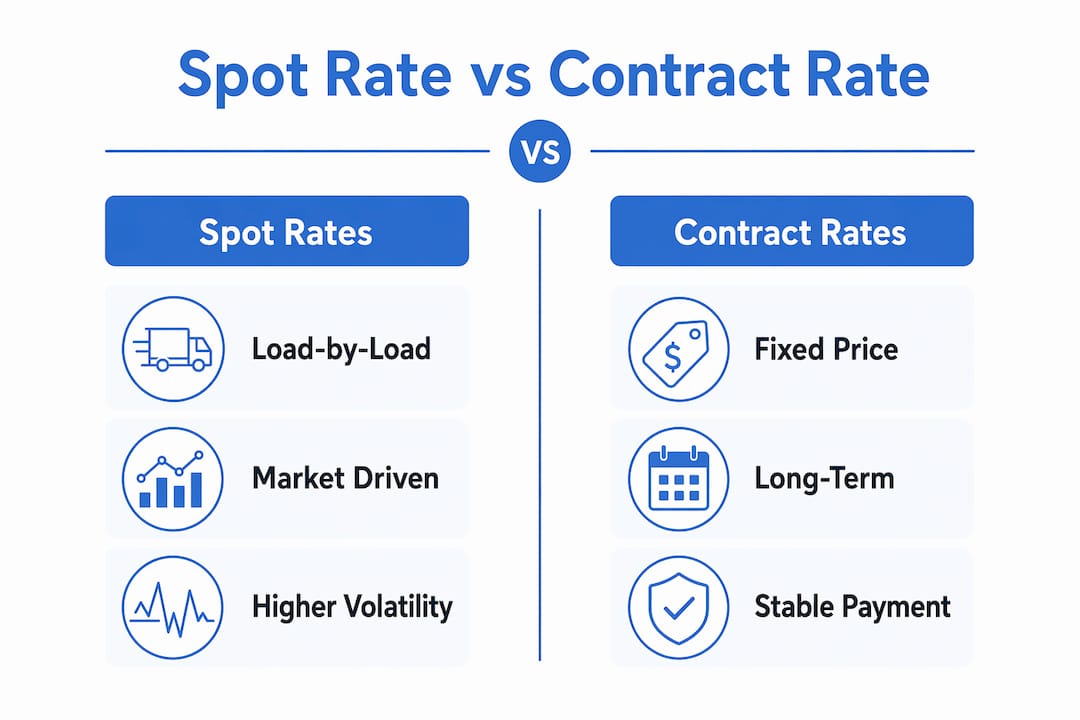
Spot market freight is booked load-by-load through load boards and brokers at whatever the current market rate is. That means your rate on Monday can look completely different from your rate on Friday. Spot pricing reflects real-time supply and demand, so when capacity tightens, rates spike. When trucks flood a lane, rates drop fast.
Contract rates work differently. A shipper and carrier agree on a fixed price per mile, lane, or load for a set period, typically 6 to 12 months, with volume minimums and scheduling commitments on both sides. Contract fixed rates give you predictable cash flow, which makes budgeting for truck payments, insurance, and fuel far more manageable.

The core tradeoff is simple: spot freight offers flexibility and the potential for higher per-mile pay when the market is hot. Contract freight offers stability and consistent volume, even when the market softens. Neither model is universally better. The best operators use both.
Spot rates result from the live balance between available trucks and available loads. When more loads than trucks exist in a region, rates climb. When trucks outnumber loads, rates fall. Several factors drive this balance:
Spot rates are also equipment-specific. Dry van, reefer, and flatbed each have their own supply and demand dynamics. Reefer rates tend to spike harder during produce season, while flatbed rates track construction and manufacturing activity closely. Tracking freight market trends by equipment type gives you a sharper read on when to push for spot loads versus locking in contracts.
Pro Tip: Set rate alerts on load boards like DAT or Truckstop.com for your primary lanes. When spot rates on a lane exceed your contract rate by more than 15%, that is a signal to evaluate whether you are leaving money on the table.
Contract rates give your operation a financial floor. You know what loads are coming, when they move, and what they pay. That predictability lets you plan driver schedules, manage fuel costs, and service debt without scrambling for loads every week.
Key advantages of contract freight include:
The tradeoff is that contract rates are typically less volatile but can run 10 to 27% lower per mile than spot rates during a hot market. That spread translates to roughly $250 to $500 less per load. However, contract loads with lower rates often outperform spot freight on net revenue because utilization stays high and deadhead miles stay low.
Pro Tip: When negotiating contracts, push for rate reopener clauses. These allow you to adjust rates mid-contract if market benchmarks shift significantly, protecting you from being locked into below-cost pricing during a freight recovery.
| Feature | Contract rates | Spot rates |
|---|---|---|
| Pricing duration | 6 to 12 months, fixed | Load-by-load, daily fluctuation |
| Revenue predictability | High | Low to moderate |
| Per-mile rate potential | Lower in hot markets | Higher in tight capacity |
| Volume commitment | Required | None |
| Deadhead risk | Lower | Higher |
The answer depends on your market position, lane mix, and risk tolerance. Neither model works in isolation for a healthy trucking business. The right approach is a deliberate blend, and the ratio should shift with market conditions.
A practical framework used by experienced operators:
Blending spot and contract freight at these ratios is the standard recommendation for carriers managing base revenue while still capturing market upside. The logic is straightforward: contracts cover your fixed costs, spot loads generate margin.
Beyond rate per mile, factor in utilization and deadhead costs. A $2.50/mile spot load with 200 miles of deadhead can underperform a $2.10/mile contract load with zero deadhead. Total revenue per truck per day is the metric that actually matters, not the headline rate.
For mature programs with regular, high-volume lanes, locking in 80 to 90% of that lane volume under contracts avoids paying unnecessary spot premiums on freight that justifies a contract. Spot market spending on predictable lanes is a cost you can eliminate with better planning.
The 2026 freight market has shifted decisively in carriers’ favor after two years of soft conditions. The recovery is supply-driven, not demand-led, which means capacity constraints are structural and likely to persist. That distinction matters for how you negotiate contracts right now.
The gap between spot and contract rates, which reached 39 cents per mile in 2025, narrowed to 11 cents per mile in early 2026. That compression signals market rebalancing. Shippers who relied on cheap spot freight during the downturn are returning to contracts for supply chain security, which is tightening spot availability further.
“The 2026 freight recovery being supply-driven implies prolonged capacity shortages, requiring long-term contract rate adjustments.” — FTR Intelligence
Key 2026 rate trends to track:
The practical implication for small fleets: if you have reliable lanes and consistent volume, this is the right moment to negotiate contracts. Shippers need capacity and they know it. You have more leverage in 2026 than you have had since 2021.
Profitability in trucking comes from total revenue and utilization, not just the rate per mile on any single load.
| Point | Details |
|---|---|
| Spot rates are volatile | Spot rates fluctuate daily based on supply and demand, reaching $2.27/mile for dry van in Q2 2026. |
| Contracts provide stability | Fixed rates over 6 to 12 months reduce revenue uncertainty and support budget planning. |
| Blend ratios matter | Use a 60/40 to 80/20 contract-to-spot ratio depending on market phase to balance stability and upside. |
| Rate reopeners protect you | Negotiate rate reopener clauses in contracts to adjust pricing when market benchmarks shift. |
| Utilization beats rate per mile | A lower-rate contract load with no deadhead often generates more net revenue than a higher-rate spot load. |
After working with small and mid-sized fleets across multiple freight cycles, the pattern I see most often is this: operators chase the highest rate per mile and ignore everything else. They see $2.50/mile on a spot load and take it without calculating the 180 miles of empty driving to get there. Meanwhile, the carrier running a $2.15/mile contract load on the same day is home earlier, burning less fuel, and netting more per hour.
The spot vs contract debate is not really about which rate model is better. It is about whether you have a deliberate strategy or you are just reacting to whatever the load board shows. Carriers without a clear strategy pay unnecessary premiums and leave revenue gaps that compound over time.
The other mistake I see constantly is concentration risk. When more than 25 to 30% of your revenue comes from a single broker or contract, one lost relationship can crater your operation. Diversification across shippers, brokers, and lane types is not just smart. It is survival.
My honest recommendation for small fleet owners right now: use the 2026 capacity squeeze to lock in contracts on your best lanes with rate reopener clauses, then keep 30 to 40% of your capacity available for spot to capture the premium while it lasts. Track your total revenue per truck per day every week, not just your rate per mile. And never let any single revenue source exceed 30% of your total book. That discipline is what separates fleets that grow from fleets that grind.
— Managment
Knowing your optimal spot-to-contract ratio is one thing. Executing it requires reliable drivers and healthy cash flow. Goeldhub connects small and mid-sized fleets with qualified CDL drivers to maintain the consistent capacity that contract shippers demand. Without dependable drivers, you cannot honor contract commitments, and losing a contract in a tight market is expensive.

Goeldhub’s low-fee factoring service solves the cash flow gap that spot market volatility creates. When spot loads pay on 30 to 45 day terms and your fuel bill is due now, factoring turns those invoices into same-day cash. Combined with data-driven freight analytics, Goeldhub gives you the operational foundation to run a mixed spot-contract strategy without the financial stress. Start your 14-day free trial with no obligation and see what the platform can do for your fleet.
Spot rates are load-by-load prices set by real-time market supply and demand, while contract rates are fixed prices negotiated for a set period, typically 6 to 12 months, with volume commitments from both parties.
Spot rates run 10 to 27% higher per mile than contract rates during tight capacity markets, but that premium disappears or reverses during freight downturns when spot rates fall below contract levels.
The recommended ratio is 60/40 to 70/30 favoring contracts in most market conditions, shifting to 80/20 during downturns to protect base revenue and moving closer to 60/40 during tight markets to capture spot premiums.
A rate reopener clause allows carriers and shippers to renegotiate pricing mid-contract when market benchmarks shift significantly, protecting carriers from being locked into below-cost rates during a freight recovery.
Compare total revenue per truck per day, not just rate per mile. Factor in deadhead miles, fuel costs, and broker fees. A $2.10/mile contract load with zero deadhead often nets more than a $2.50/mile spot load requiring 150 miles of empty driving.


.svg)